
An AI agent in B2B sales is not rule-based automation, it is a system that makes its own decisions

Author: Justyna Brończyk
Key Projects Lead
· 7min read

A B2B sales team loses most of its time not in conversations with customers, but in everything that happens between them: qualifying an enquiry, checking stock, preparing a quote, chasing an offer that has gone unanswered for a week. Classic automation can handle a single, predictable step of that process. An AI agent can do more: it assesses the situation on its own and decides what to do next.
How is an AI agent different from the automation you already know?
Most companies already have some automation in sales: an autoresponder after a form is submitted, a CRM reminder after X days of silence. It works well as long as the situation fits a scenario planned in advance. The trouble starts when a customer writes something the script did not anticipate.
- Rule versus intent: an autoresponder fires after a single event and sends a ready-made template. An AI agent reads the message and works out what the customer is really asking, even if they phrased it differently from what the scenario assumed.
- Fixed path versus a decision that fits the context: classic automation has one route for each case. The agent picks the next step to suit the situation, one for a regular customer with an agreed discount, another for a new contact from an industry the company has not worked with yet.
- A one-off form versus data from your systems: before the agent replies, it checks the CRM, ERP and PIM. Its decision is based on the current state of the business, not on information typed by hand into a single field.
The difference is not cosmetic. It is a shift from “carry out a programmed action” to “assess the situation and choose what to do”, and that is why an agent can keep going where ordinary automation stops.
Which B2B sales tasks can you realistically hand over to an agent?
Qualifying leads before they reach a sales rep
The agent checks each enquiry against your ideal customer profile (industry, company size, volume, purchase history) and gives it a priority. The sales rep gets contacts that are already sorted, instead of going through every form submission by hand.
Follow-ups and instant quotes
Instead of a single reminder sent after a week of silence, the agent runs a multi-step conversation, picks the right moment for the next message and answers technical questions before the case even reaches a person. When a customer asks for a quote, the agent checks availability in the ERP and specifications in the PIM, and generates a ready document in seconds, rather than waiting for someone to do it by hand the next morning.
Upsell signals and churn risk
By analysing order history, the agent can spot two things that are easy to miss when you manage a large customer base by hand: a good moment to suggest a complementary product, and a drop in order frequency that usually comes before a customer leaves. The sales rep gets a specific recommendation instead of having to study each customer’s sales charts one by one.
Which systems does the agent need to see for this to work?
An AI agent does not replace your CRM, ERP or PIM. It lives on the data those systems already hold. The CRM gives it the contact history and lead status, the ERP gives it stock levels and commercial terms, and the PIM gives it product specifications and descriptions. Without access to all three, the agent has nothing to build a sensible answer from.
To reduce the risk of the agent “making up” information that is not in any of those systems, you use a technique called RAG (Retrieval-Augmented Generation): the agent answers only on the basis of facts retrieved from the company’s internal knowledge base, not from the model’s general knowledge. Final control over what reaches the customer stays with a human-in-the-loop setup: the agent prepares the message and the calculation, and the sales rep approves sending it.
We saw how much the data foundation matters when we built a custom CRM for a car sales and leasing network. As long as leads and sales opportunities sat in spreadsheets scattered across people, no automation, let alone an AI agent, had anything to work with. First you get the data in order in one system, and only then do you add an AI layer on top.
Does this mean the sales team will become unnecessary?
No. Large B2B contracts are still won through conversation, negotiation and relationships, and an agent will not take that over. What actually disappears is the admin around those conversations: retyping data, keeping track of follow-up dates, putting together a quote from three different systems. Sales reps stop being spreadsheet operators and get time back for what really decides the outcome of a negotiation.
Where do you start with an AI agent in your sales team?
Before you decide which tool to use, check which tasks in your sales team are suitable for AI at all. That is the same approach behind our AI audit and training for businesses. Only after such an audit does it make sense to integrate with the CRM and ERP and set up the model in a human-in-the-loop mode. The first measurable results, such as faster responses to enquiries and fewer hours spent on admin, usually show up after a few weeks of working this way, not on the first day.
If you are just starting the conversation about AI in your company, we explain why the audit really matters in the article why AI training starts with an audit. You can read more about building AI solutions, including recommendations, integrations and machine learning models, on our AI and Machine Learning services page.
We also talk about personalization in B2B, and how customer behaviour data feeds both recommendations and AI agents, in an episode of the Manufaktura e‑commerce podcast.
Wondering which tasks in your sales team could be handed over to an AI agent? Contact Endora: we will audit your processes and show you where to start.
Keywords: AI agents in B2B sales, B2B sales automation, AI SDR, lead scoring, CRM ERP PIM integration, human-in-the-loop
Our services
Full-spectrum B2B e‑commerce support
B2B sales platforms on Magento, Shopware, Sylius and Endora Commerce: per-customer price lists, RFQ, a customer portal and ERP integration.
Implementation of ERP and PIM SystemsERP and PIM implementation and integration (Pimcore, Akeneo, Ergonode) for online sales: one source of product data, prices and stock for your store and marketplaces.
E‑commerce Consulting and AnalysisB2B e‑commerce consulting: online sales strategy, platform selection, implementation roadmap and data analytics (GA4, Power BI, Looker Studio). Decisions based on data, not gut feeling.
Keep reading
Recently published

How much does a B2B platform cost? What goes into implementation and running costs
The licence is only the start. What a B2B platform really costs: implementation, integrations, migration and maintenance. How to compare quotes and work out TCO.
Read more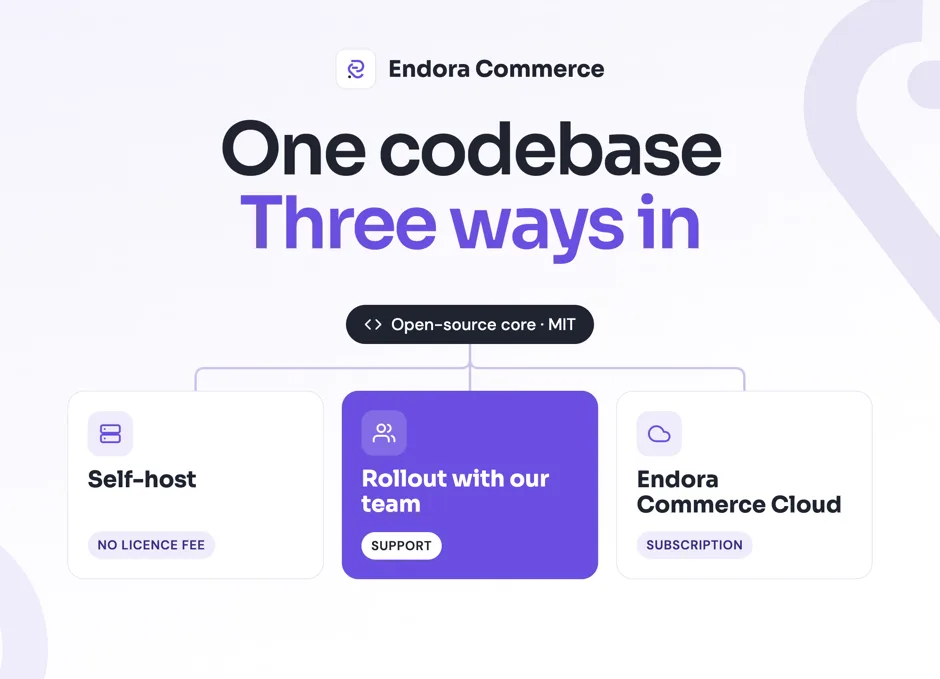
Self-hosting, a guided rollout or Cloud: how to choose your way into Endora Commerce
One codebase, three ways in: when self-hosting Endora Commerce pays off for a B2B company, when a rollout with Endora's team does, and when Cloud fits.
Read more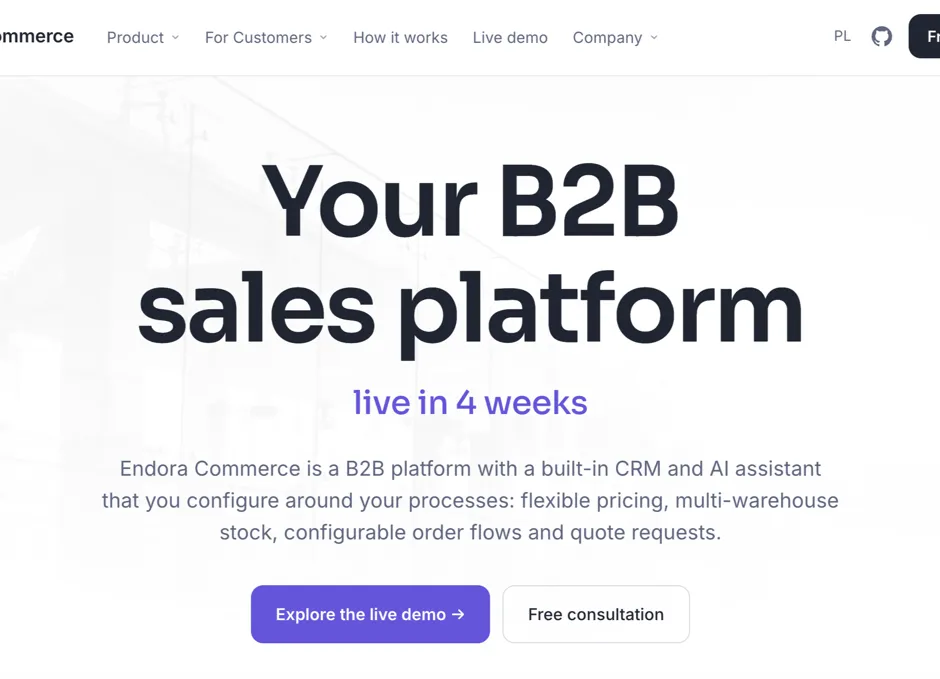
Endora Commerce under the MIT licence: what open code changes when you choose a B2B platform
Endora Commerce is now open source under MIT. What it means for a B2B company: code ownership, paid modules, and self-hosting vs a rollout vs Cloud.
Read more
Google Ads for B2B: how to optimize campaigns for lead quality
How to set up conversions, assign value to leads and connect CRM data so that your B2B Google Ads campaigns stop optimizing for the number of forms and start optimizing for real sales.
Read more
Why I Started the Manufaktura E‑commerce Podcast
Michał Zabielski on how the Manufaktura E‑commerce podcast started, who it's for, and what episodes you'll find. 22 episodes about building B2B platforms.
Read more
A B2B Sales Platform for Manufacturing: ERP, PIM and Online Sales in One Place
A B2B sales platform for manufacturing brings ERP, PIM and online sales into one process. See how industrial companies can sell online without data chaos.
Read more
Endora Commerce features: which modules a rollout starts with
How we match Endora Commerce modules to a B2B company’s processes: pricing, orders, warehouses and channels. The full catalog is on the product site.
Read more
Endora Commerce industries: how we match a rollout to your business
How we tailor an Endora Commerce rollout to the industry: manufacturing, technical distribution, wholesale, MRO, building materials and automotive parts.
Read moreHave a specific challenge?
Don't just read about it - let's talk about your case.