
How much does a B2B platform cost? What goes into implementation and running costs

Author: Justyna Brończyk
Key Projects Lead
· 8min read

In short: A B2B platform costs far more than its licence or subscription. Total cost of ownership (TCO) also covers implementation, ERP and PIM integrations, data migration, infrastructure, maintenance, development after launch and the cost of switching vendors later. To compare quotes fairly, you have to cost them over the same period, ideally several years, and ask vendors about the items that don’t show up in the first estimate.
Why are B2B platform quotes so hard to compare?
In workshops with B2B leadership teams I often see three quotes on the table, none of which lines up with the others. The first has a high licence fee and a low implementation cost. The second has a low subscription but prices integrations separately. The third is heavy on implementation work with no licence fees at all.
Each of them can be perfectly fair. The problem is that they price different things over different timeframes. So instead of asking “which quote is cheapest?”, a better question is: what will this platform cost me over the next few years, including everything I actually need to sell?
What makes up the cost of a B2B platform?
Licence or subscription
This is the most visible item. Proprietary platforms usually charge a licence or a subscription, often tied to revenue, number of users or number of orders. Open-source platforms such as Magento Open Source or Endora Commerce under the MIT licence charge no licence fee for the core. It’s still worth checking which modules are paid separately.
Implementation and process fit
B2B sales rarely work “out of the box”. Customer-specific price lists, credit limits, roles in company accounts, requests for quote and order approval flows all have to be configured for a specific business. What drives the cost most is how many of your processes depart from the standard, and whether it makes more sense to change them or to model them in the platform.
ERP, PIM and other integrations
In many projects this is the largest and most underestimated item. A B2B platform has to exchange data with the ERP (prices, stock, documents, receivables), often with a PIM (product data), and with payment gateways, carriers and the invoicing system, including KSeF, Poland’s national e-invoicing system. Every integration means not only building it but also handling errors, monitoring it and keeping it working when the ERP changes. If you’re still choosing a system, see our ERP comparison: Comarch XL, enova365 and Subiekt GT.
Projects such as a Magento B2B rollout integrated with Pimcore and Subiekt taught us that integration quality translates directly into how many customers call to ask about prices and availability. How we plan these connections step by step is covered in the piece on Endora Commerce integrations with ERP, payments and KSeF.
Data migration and clean-up
Moving products, customers, price lists and order history from an old system almost always exposes messy data. Duplicate accounts, inconsistent units of measure or missing attributes have to be fixed before launch, or they go straight into the new platform.
Infrastructure and hosting
Servers, test environments, backups, CDN and monitoring. In a SaaS or Cloud model this cost is usually part of the subscription. If you host it yourself, you carry it yourself, along with responsibility for uptime and security.
Maintenance and updates
A platform doesn’t stand still after launch. There are security patches, new framework versions and changes in the systems it’s integrated with. Skipping updates only postpones the cost, and it comes back with interest, as we wrote about in the piece on the risk of not updating your CMS.
Development after launch
The first version of a platform is rarely the last. After a few months, sales reps and customers raise needs nobody could have foreseen during analysis. It pays to plan a budget for platform maintenance and development from the start, rather than treating every change as a surprise.
Your team’s time
This cost never appears on an invoice, but it’s real. Someone on your side has to join workshops, test, prepare data and train the sales team. The better prepared the implementation, the less of your people’s time it takes.
The cost of switching vendors
This is the item people ask about least before signing. What happens if, in a few years, you want to change technology partner or the vendor raises prices? With a proprietary platform and code owned by the vendor, switching usually means rebuilding everything. With open code that stays in your company, you can carry on development with another team.
Which costs only show up after launch?
Many budgets slip not because of bad faith on the vendor’s side, but because of things nobody named at the quoting stage. Most often these are:
- Extra modules: B2B features that aren’t in the base version of the platform.
- Integrations “to be confirmed”: items without a price in the quote that turn out to be the biggest part of the budget after launch.
- Revenue-based fees: they grow with your sales, so the platform’s success raises its cost.
- Support hours outside the package: billed separately when the SLA package turns out to be too small.
A good quote doesn’t have to be the cheapest. It does have to say clearly what’s included and what isn’t.
What should you ask vendors to compare quotes?
| Question | Why it matters |
|---|---|
| Who owns the code after implementation? | It determines the cost of switching vendors in the future |
| Which modules and integrations are included, and which are paid separately? | It helps you avoid items that appear after launch |
| Do fees depend on revenue, number of users or orders? | The cost may grow along with your sales |
| What does maintenance cover, and how fast do you respond to incidents? | It shows the real cost and risk after go-live |
| Who is responsible for updates and security? | Without this, it’s easy to end up with a gap in responsibility |
| How much time will our team need? | An internal cost that never appears on an invoice |
How do you work out the TCO of a B2B platform?
Total cost of ownership is best calculated over several years, for example 3. Over that period you see maintenance and development costs, not just the launch.
In a spreadsheet, enter every component described above for each quote:
- One-off cost: implementation, integrations, data migration.
- Recurring costs for each year: licence or subscription, infrastructure, maintenance.
- Development budget: changes and new features after launch.
- Your team’s time: an estimate of hours for workshops, testing and training.
- Exit risk: what switching vendors would cost after 3 years.
Only a breakdown like this lets you compare quotes that look completely different at first glance.
How much does Endora Commerce cost?
The Endora Commerce core is available free of charge as open source under the MIT licence. We earn from implementation and consulting, not from licence fees.
The open-source edition is a complete B2B store with an admin panel. Ready-made integrations, for example with ERP, PIM, payment gateways and carriers, are paid. On rollouts delivered by Endora they are part of the price agreed upfront, not a separate item after launch. If you don’t want to run infrastructure, the same platform is available on a subscription as Endora Commerce Cloud, where you’ll find the plans and what they include.
The code stays with you whichever path you choose, so the cost of switching vendors later is much lower than with a proprietary platform. Which path to choose, and how to cost each one, I covered in the piece on self-hosting, a guided rollout or Cloud.
FAQ
How much does it cost to implement a B2B platform?
It depends mainly on the number and complexity of integrations, the state of your data and how far your sales processes depart from the standard. A reliable estimate is only possible after analysis, ideally in a workshop.
Is an open-source platform cheaper than a proprietary one?
There’s no licence fee for the core, but you still pay for implementation, integrations and maintenance. Its biggest cost advantage is usually the lower cost of switching vendors in the future.
What is the TCO of an e-commerce platform?
TCO (Total Cost of Ownership) is the total cost of owning a platform over a given period. It covers one-off, recurring, development and internal costs, not just the purchase price.
What should you watch out for in a B2B platform quote?
Integrations priced as “to be confirmed”, revenue-based fees, extra paid modules and no clear answer to the question of who owns the code.
Want to work out what a B2B platform would cost your company? Book a free consultation, and we’ll go through it using your own processes and systems.
Our services
Full-spectrum B2B e-commerce support
Keep reading
Recently published
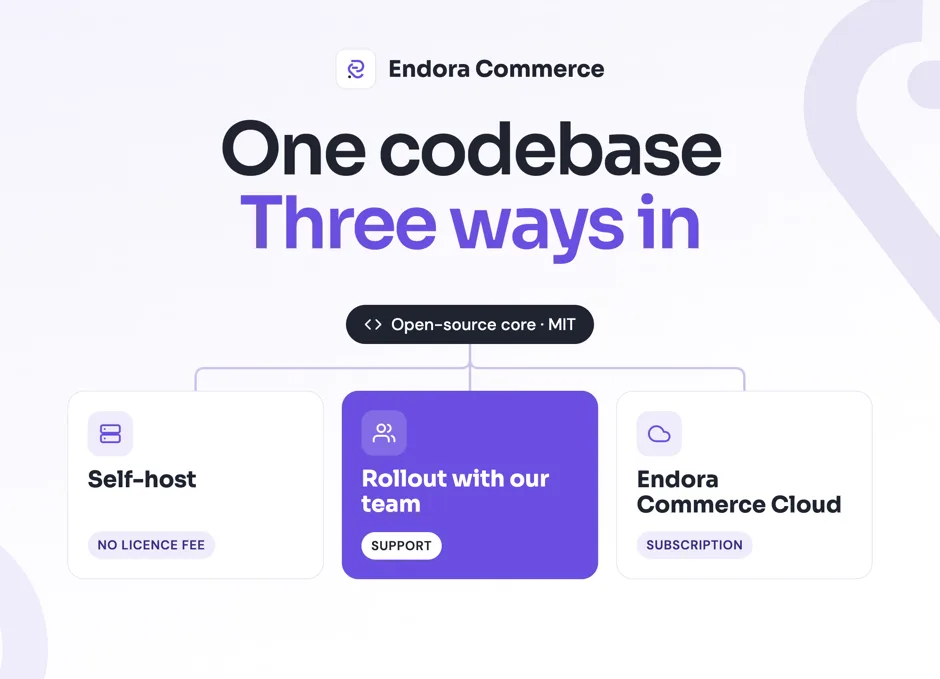
Self-hosting, a guided rollout or Cloud: how to choose your way into Endora Commerce
One codebase, three ways in: when self-hosting Endora Commerce pays off for a B2B company, when a rollout with Endora's team does, and when Cloud fits.
Read more
Endora Commerce under the MIT licence: what open code changes when you choose a B2B platform
Endora Commerce is now open source under MIT. What it means for a B2B company: code ownership, paid modules, and self-hosting vs a rollout vs Cloud.
Read more
Why I Started the Manufaktura E-commerce Podcast
Michał Zabielski on how the Manufaktura E-commerce podcast started, who it's for, and what episodes you'll find. 22 episodes about building B2B platforms.
Read more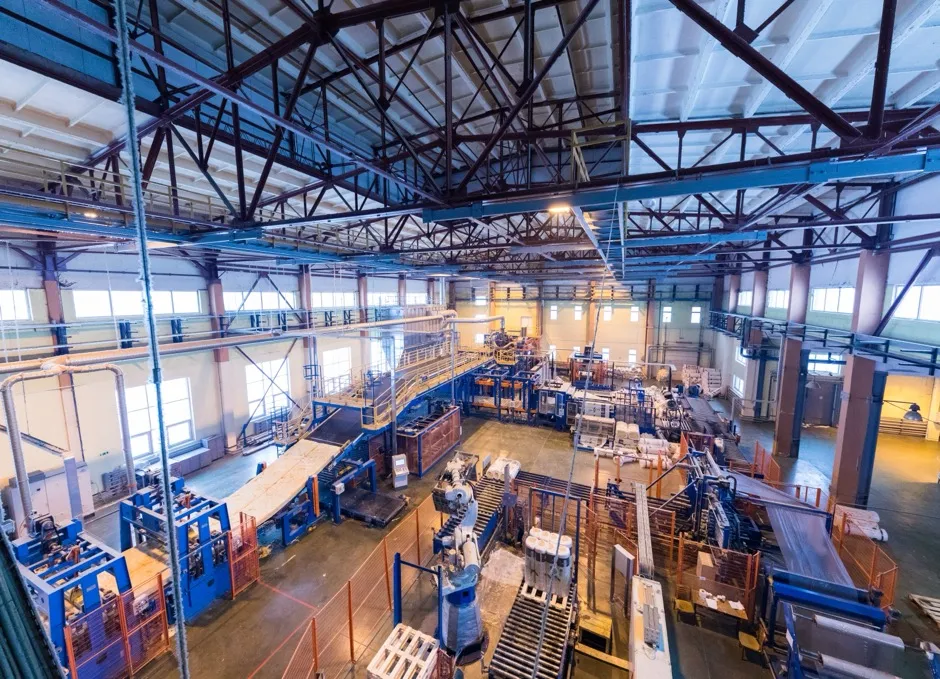
A B2B Sales Platform for Manufacturing: ERP, PIM and Online Sales in One Place
A B2B sales platform for manufacturing brings ERP, PIM and online sales into one process. See how industrial companies can sell online without data chaos.
Read more
Endora Commerce features: which modules a rollout starts with
How we match Endora Commerce modules to a B2B company’s processes: pricing, orders, warehouses and channels. The full catalog is on the product site.
Read more
Endora Commerce industries: how we match a rollout to your business
How we tailor an Endora Commerce rollout to the industry: manufacturing, technical distribution, wholesale, MRO, building materials and automotive parts.
Read more
A B2B Platform for Distributors: Pricing, RFQ and ERP Integration
A B2B platform for distributors differs from a standard online store: per-customer price lists, RFQ and ERP integration. See which features you actually need.
Read more
Software for the Automotive Industry: Website, B2B System and Rollout
Software and a website for the automotive industry are more than an e-commerce template. See how to order a B2B system for a dealer or parts distributor.
Read moreHave a specific challenge?
Don't just read about it - let's talk about your case.