
Endora Commerce: 12 years of B2B rollouts in one platform
How the Endora core team turned 120+ B2B rollouts into Endora Commerce: open source under the MIT licence, 80 modules and a live demo you can test.
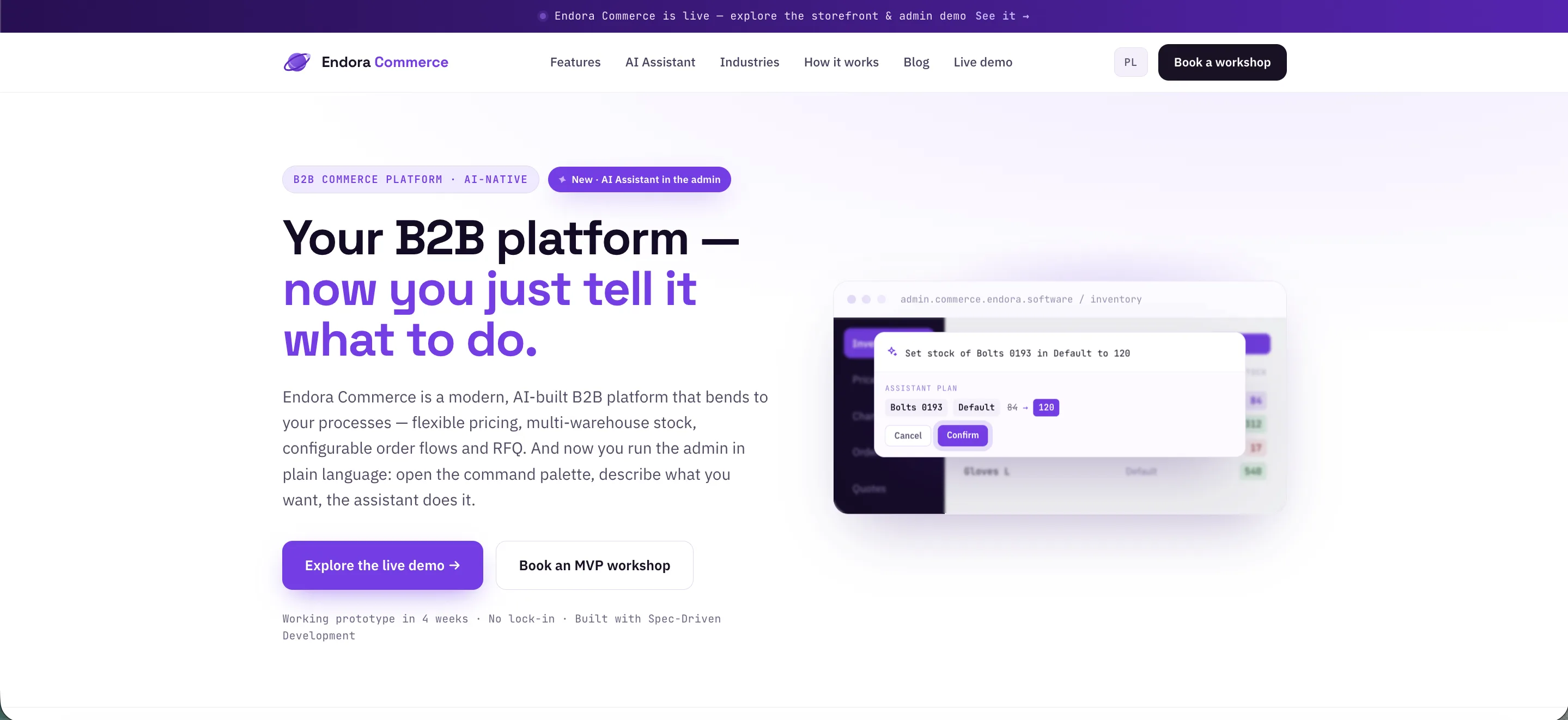
- 4 wks
- from workshop to production launch
- 80
- open-source modules and 25 integrations as standard
- 0
- lock-in, MIT-licensed open source code and specs that belong to you
- Client
- Endora (own product)
- Industry
- B2B Sales Platforms
- Scope
- Architecture, specifications and development of a B2B platform by the Endora core team: Spec-Driven Development, AI-assisted coding with code review, a live demo and an open source (MIT) release
- Technologies used
- Next.jsTypeScriptNode.jsDocker
Live demo, check for yourself
🛒 Storefront
The B2B buying experience, catalogue, pricing, RFQ
buyer@demo-org.example
ChangeMe!123
⚙️ Admin panel
The control centre, pricelists, statuses, channels, warehouses
admin@demo.local
ChangeMe!123
Why we built our own platform
Selling complex B2B technology solutions has one fundamental problem: the client cannot "touch" the product before making a decision. Instead they receive a presentation, a proposal, a quote, and must imagine how all of this will work in their company.
This creates long decision cycles, multiple rounds of negotiation and high risk on the client's side. From an agency's perspective this means months from first contact to contract signing, and intensive presales work without guaranteed conversion.
Instead of explaining how the platform works, we decided to show it. The demo shifted the conversation from "trust us" to "check for yourself".
Building Endora Commerce as our own product also let us validate our methodology in real conditions. The platform is our first client, we use it internally, which allows continuous feature refinement and immediate testing of new approaches.
Spec-Driven Development with AI, how we build it
We develop Endora Commerce with the same methodology we apply to client projects. Endora engineers describe every feature in a plain-language specification: requirements, edge cases, test scenarios. AI speeds up writing the tests, code and documentation, and every change goes through code review by the team before it reaches the repository. That way everyone on the team knows what shipped and why.
The same code as production
A key architectural decision: the demo runs on the same stack as the production platform: Next.js and TypeScript, with the code in a public repository. There is no separate "demo codebase" with simplified logic. What the client sees in the demo exactly matches what they will get in production. Every fix reaches both environments automatically.
Who develops Endora Commerce?
Endora Commerce is developed by the Endora core team, the same team that has delivered more than 120 e‑commerce projects on Magento, Shopware and Sylius since 2013. Every module answers a need we saw in client rollouts: contract pricelists, buyer organisations, quote requests, multi-warehouse stock and ERP integrations.
- Open source under the MIT licence: the code is in a public GitHub repository and the packages are on npm. Your technical team can assess the code quality before you decide on a rollout.
- Documentation and community: the documentation covers installation and every module, and we handle questions and issues on GitHub and Discord.
- A model that funds development: paid integrations (payment gateways, PIM, KSeF and more) fund the team maintaining the platform core. On Endora rollouts they are part of the agreed project cost.
- Partner programme: implementation companies can build their own solutions on Endora Commerce with a direct line to the product team.
Read more about the release in Endora Commerce is now Open Source.
Storefront. B2B from the buyer's perspective
The storefront demo runs as Industria, a fictional B2B industrial component distributor with 120,000+ SKUs. Net prices, credit limit visible immediately after login, data sheets and 3.1 certificates on every product. PL/EN available without additional configuration.
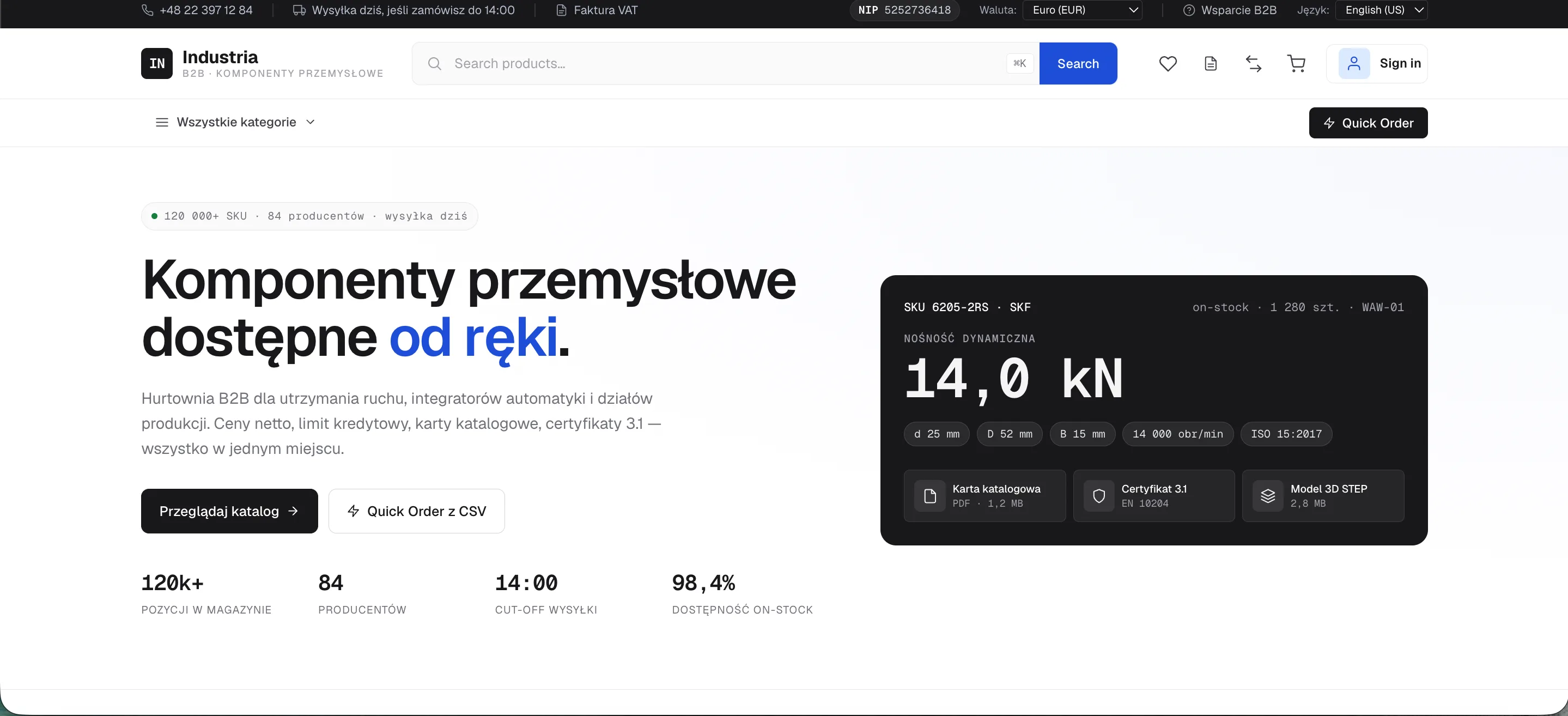
The buyer's homepage
The buyer immediately sees what matters most in B2B: on-stock availability, shipment cut-off, credit limit and fast search. Quick Order from a CSV file reduces repeat orders from dozens of clicks to one.
Filtered listing, no page reload
Filters by colour, material, weight and manufacturer work instantly. The buyer sees on-stock availability and can sort by relevance. The mobile view supports the full buying journey, an increasing share of B2B orders are placed from phones.


Cart → quote request in one click
The customer builds a cart and clicks "Convert to quote request", the system sends an RFQ with proposed prices. The sales rep negotiates in the admin panel and converts the accepted quote to an order. The full negotiation cycle without emails and spreadsheets.
Admin panel, the control centre
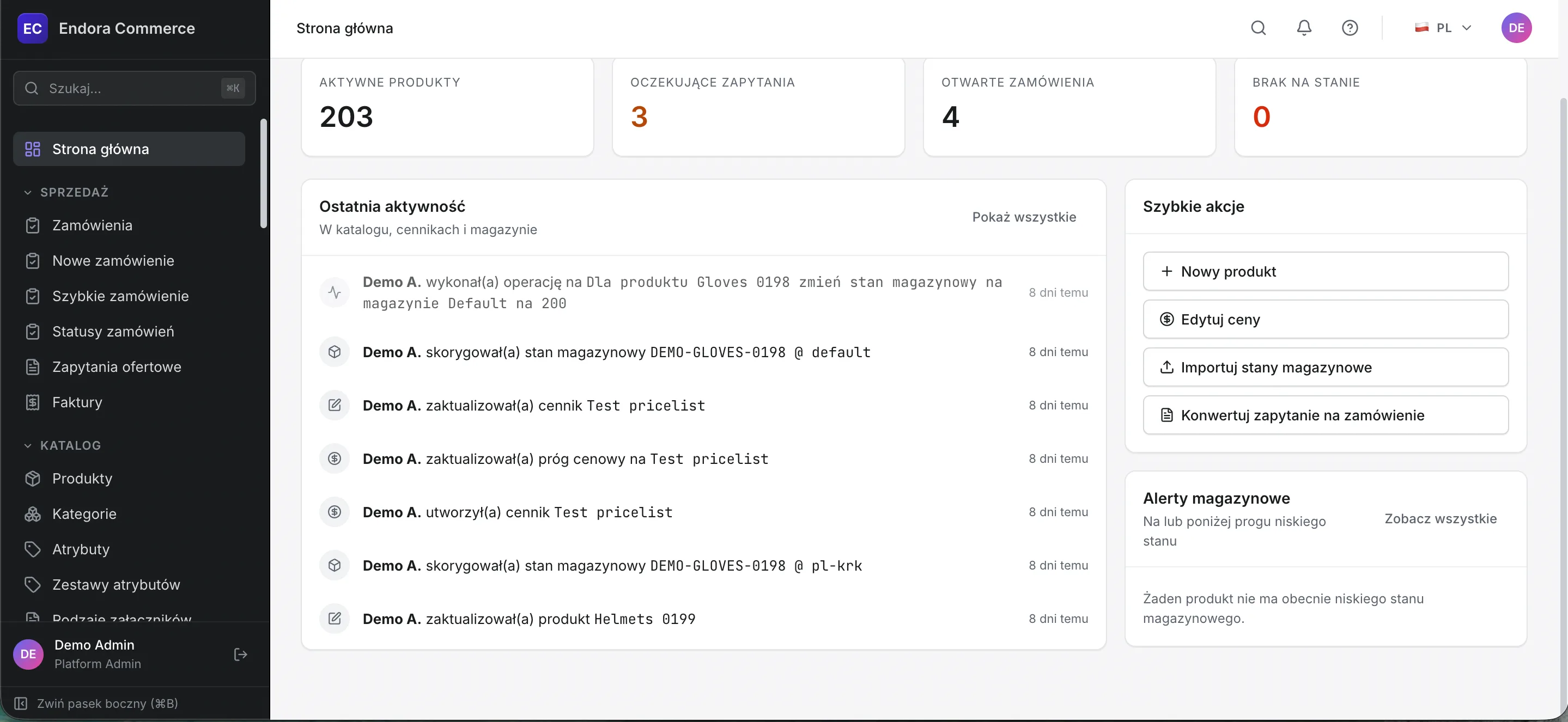
Live activity dashboard: real-time data from the audit_log module shows actions in the catalogue, pricing and inventory. The order list filters by status, sales channel and date, one panel handles B2B VIP and retail with separate priorities.
Dashboard with full visibility
203 active products, 3 pending quote requests, 4 open orders, and instant stock alerts. The recent activity feed lets you see what changed since your last login, without searching through logs.
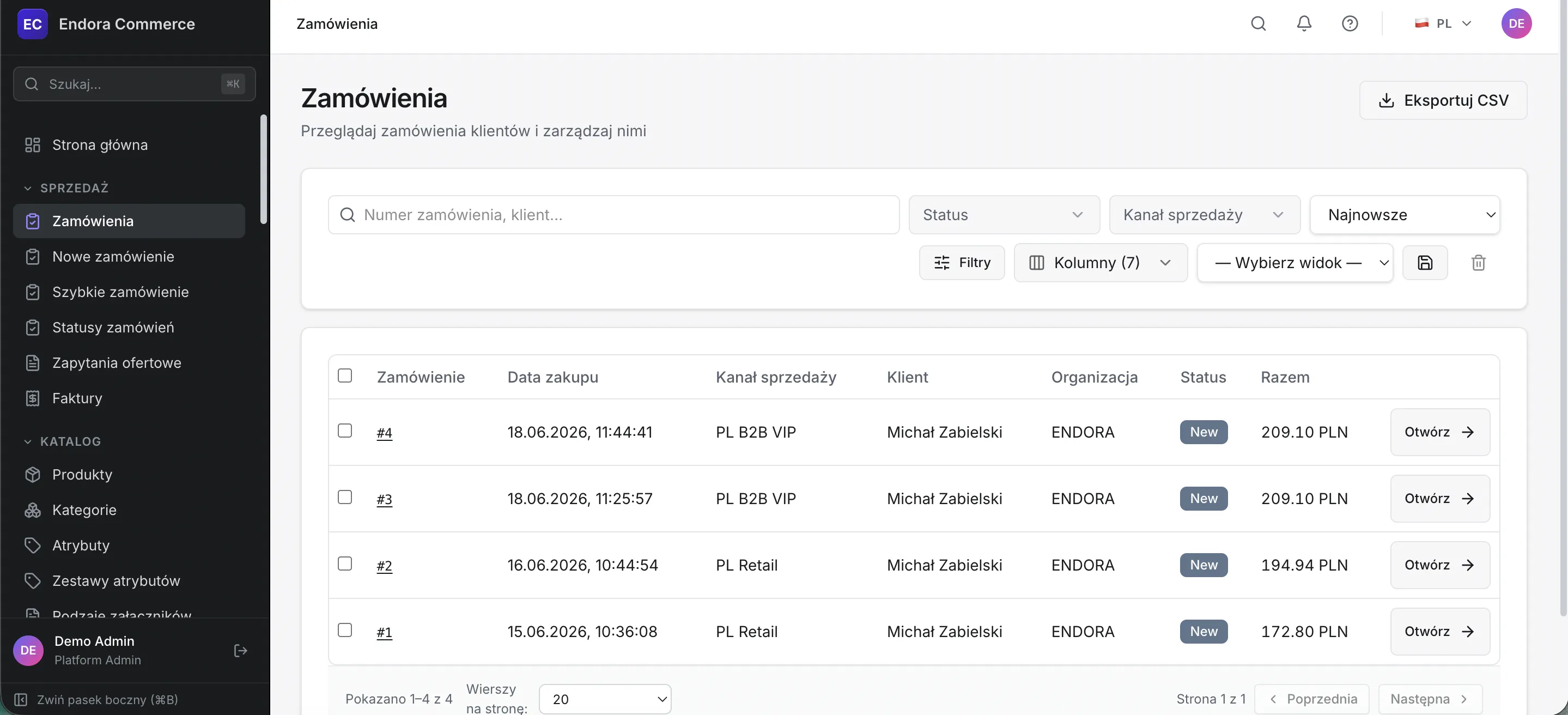
Orders from multiple channels, one view
Each order has an assigned client organisation and sales channel. Manage B2B VIP and retail simultaneously from one panel, with separate statuses, priorities and pricelists. Live configurability: a pricelist change is reflected on the storefront instantly, no reload needed.
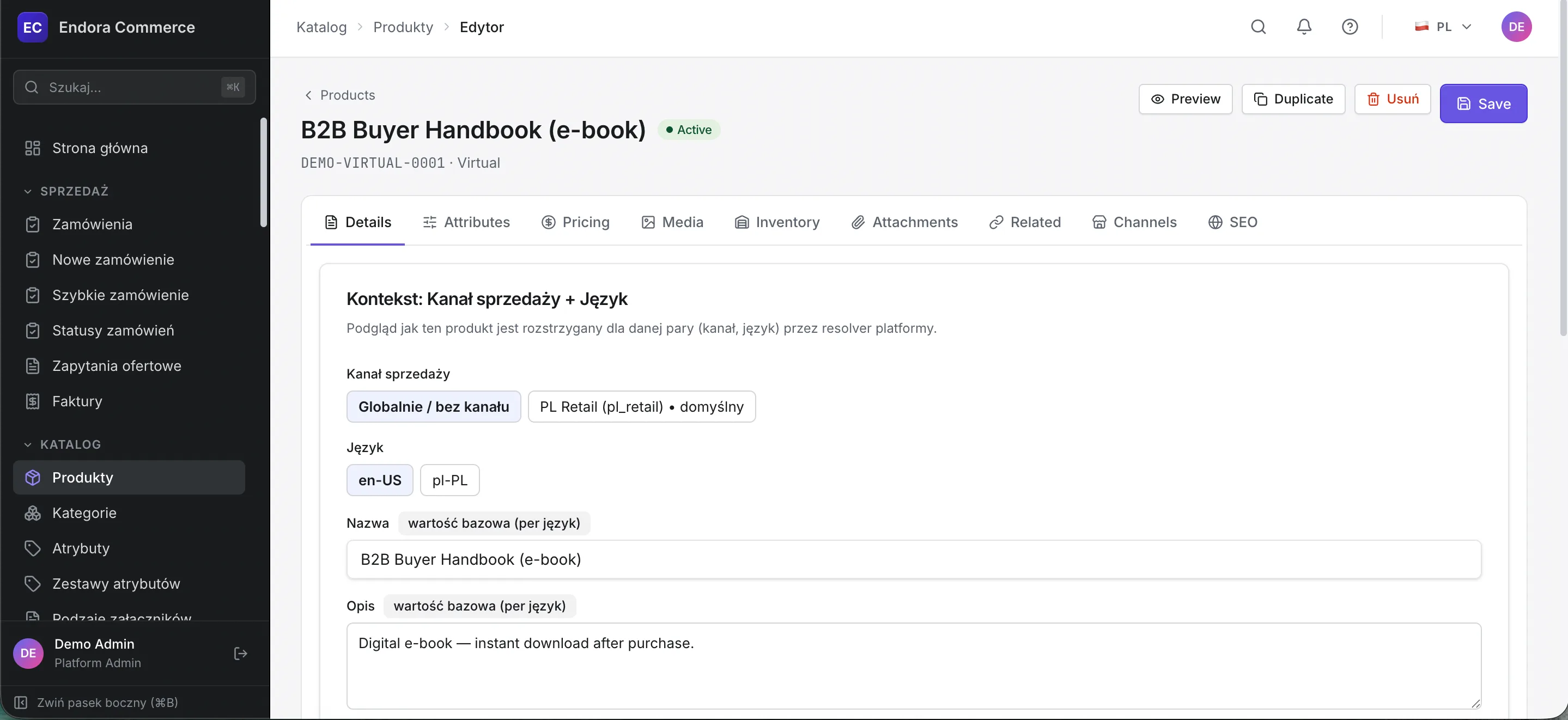
Product in multiple channels and languages
The product editor handles multiple sales channels and languages simultaneously. Each (channel + language) pair can have its own name, description and attributes without duplicating records. One product, multiple sales contexts.
AI Assistant, the "wow moment" of every demo
Endora Commerce has an AI assistant built directly into the admin panel. Open the palette ⌘K, describe the task and the platform executes it, showing the action plan before anything changes.
The assistant operates only within user permissions, handles bulk operations and resists prompt injection from external data. Every action is recorded in the audit log, you know who changed what and when.
How the demo shortens the sales cycle
Without a demo
- Slides and value propositions as the only proof
- The client must imagine how the system works
- Multiple rounds of technical verification
- Management decides based on abstraction
- Months from first contact to signed contract
With a live demo
- The client sees a working system before any decision
- Sales reps test the buying journey themselves
- IT confirms the API-first architecture on the spot
- Decision based on real experience, not imagination
- Realistic expectations from day one of the project
Three demo access models
Demo without registration
Live environments available to anyone, link, test account, access. Minimum friction. The client can explore at any time without involving a sales rep.
Your scenario, your data
An instance configured for a specific prospect: catalogue from their category, pricelists similar to their structure, integration with the ERP class they use. The client tests their own scenario, not an abstraction.
Demo as a starting point
Instead of a requirements workshop from scratch, we show the demo and ask: "what would you change?". The client reacts to what they see. Feedback is more concrete, discovery time shorter.
Six modules most rollouts start with
The platform has 80 open-source modules and 25 integrations. Below are the six we most often start with. See the full overview of every Endora Commerce feature →
Pricing engine & pricelists
Multiple pricelists per customer group, individual discounts and contracts, volume pricing, overlapping rules with priorities. You change from the interface, not the database.
Configurable order statuses
Design your own order lifecycle: add statuses, define transitions, attach business events (e.g. ERP sync). Built-in On Hold and Cancelled branches.
Request for Quote (RFQ)
Customer builds a cart and requests a quote, sales rep negotiates and converts to an order. The full negotiation cycle without emails and spreadsheets.
Multi-warehouse inventory
Multiple warehouses, low-stock thresholds per product and per channel, warehouse-to-channel assignment, configurable stock deduction strategies.
Sales channels
One panel manages the B2B storefront, marketplaces (Allegro), distributor platforms, mobile apps and POS. Separate prices, content and product visibility per channel.
ERP/PIM/WMS/CRM integrations
Clean API and event model allow connecting any external system. The platform syncs orders with ERP, stock from WMS and customer data from CRM. See the full list of integrations →
Industries
Endora Commerce works where prices are negotiated, catalogues run deep and logistics are real, manufacturing, technical distribution, wholesale, MRO, building materials, automotive parts. See the full breakdown, with concrete features for each of the 6 sectors, in industries where Endora Commerce works.
| Industry | Key needs |
|---|---|
| Manufacturing | Configurable products, contract pricing, production-aware order flows |
| Industrial & technical distribution | Deep catalogues with dozens of parameters, product comparison |
| Wholesale & trade | Customer-group pricelists, volume pricing, fast reordering |
| MRO & spare parts | Huge SKU counts, multi-warehouse stock, quick quotes |
| Building materials | Bulk pricing, multi-warehouse logistics, delivery planning |
| Automotive parts | Parameter-rich catalogues, product comparison, RFQ-driven sales |
Curious what Endora Commerce integrates with or which modules it offers? Read how we plan integrations or which modules a rollout starts with.
If your industry isn't on the list but you sell B2B with individual pricelists or quoting, let's talk.
Live in 4 weeks: how the start looks
Week 1: MVP Workshop
We map your sales processes, industry constraints and first-launch scope. The output is a specification: statuses, pricelists, channels.
Weeks 2-4, Build
We configure ready-made modules and build what your industry needs on top, using AI-assisted Spec-Driven Development. Every feature starts from a specification and goes through code review.
Week 4: Production launch
A simpler implementation goes live in production with your real products, processes and pricelists. With a more complex scope you receive a working prototype and together you decide on full implementation or further MVP iteration.
Want to see Endora Commerce in the context of your industry?
Book an MVP workshop, we'll map your processes and show you how the platform can look for your business. No commitment.
See next
More case studies


Have a specific challenge?
Don't just read about it - let's talk about your case.