
Endora Commerce under the MIT licence: what open code changes when you choose a B2B platform

Author: Justyna Brończyk
Key Projects Lead
· 5min read
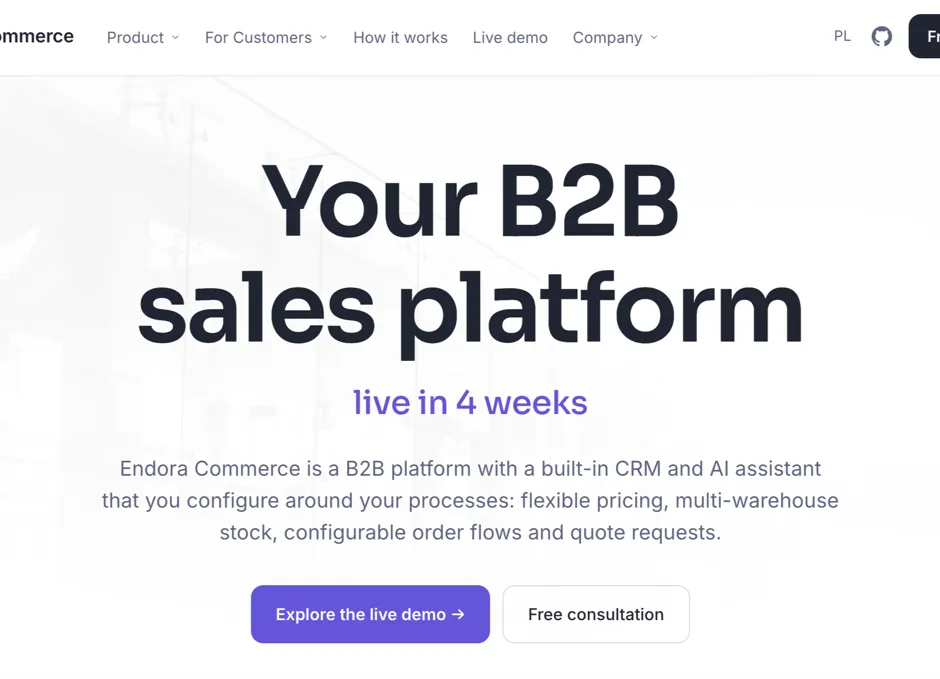
Since October, Endora Commerce has been available as open source under the MIT licence. What the open version includes and how to start it with two commands is covered in the release announcement on the product site. Here I want to look at the decision from a different angle: that of a company choosing a B2B platform right now and wondering what open code changes for them.
Which questions do I hear most often when companies choose a platform?
In workshops with B2B management teams, the same three questions come back regardless of industry:
- Who owns the code? Can the company keep developing the platform with a different team after the rollout?
- What if the vendor raises prices or leaves the market? A closed subscription is a dependency that is hard to price on the day you sign the contract.
- What does the platform cost after launch? Licences, extra modules and integrations have a habit of showing up on the invoice only after go-live.
I think these are exactly the questions worth asking every vendor. Opening the Endora Commerce code answers the first two directly. The third is answered by a clear split between free and paid modules.
What does the MIT licence mean in practice?
MIT is one of the most permissive open source licences. For a B2B company it comes down to three things:
- Run it yourself: you can host the platform core on your own server, with no licence fee.
- Develop it freely: you can change the code on your own, with Endora or with another technology partner.
- No dependency on a single vendor: if the partnership stops working for you, the code stays with your company.
The last point matters most to me. I have written before about what happens to the relationship between a client and a service provider when trust is lacking. Trust is easier to build when the client has a real option to leave. If they stay, it is because the partnership works.
Which parts are free and which do you pay for?
The open source version is a complete B2B store with an admin panel. Among other things, it covers a catalog with organisation-specific prices, company accounts with roles and credit limits, quote requests, quick orders, and order and returns handling. You will find a full description of the modules in the Endora Commerce feature catalog.
The ready-made integrations are paid: payment gateways, PIM and ERP systems, carriers and invoicing systems. The list, with a description of each connection, is on the Endora Commerce integrations page. The layers these integrations are built on are part of the open version, so your team can write an adapter for the system you use on its own.
On rollouts delivered by Endora, paid modules are part of the agreed rollout cost. They do not appear as a separate line item after launch.
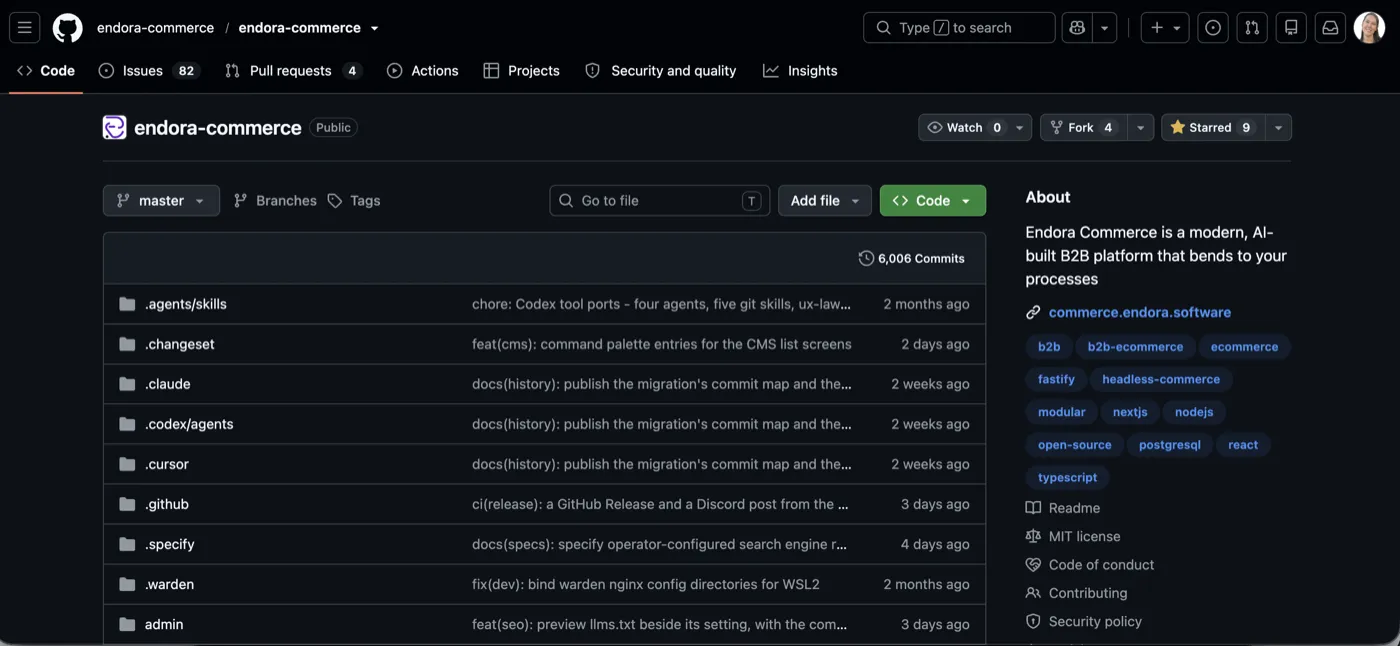
The public Endora Commerce repository on GitHub: the code, the MIT licence and the contribution rules in one place.
Self-hosting, a rollout or Cloud: which should you choose?
Open code does not mean every company should install the platform on its own. I see three paths:
- Self-hosted open source: when you have an in-house development team that knows Node.js and you want to start from the platform core. Requirements and instructions are in the Endora Commerce documentation.
- A rollout with the Endora team: when you need ERP integration, data migration and a platform shaped around your sales processes. We start with a workshop, and how the rollout works is described step by step. Our wider approach to B2B sales platforms is on the service page.
- Endora Commerce Cloud: when you do not want to maintain your own infrastructure. It is the same platform as a subscription, with the plans described on the Endora Commerce Cloud page.
In my view, most mid-sized B2B companies will pick the second or third path. Open code still gives them something a closed subscription cannot: the option to change the decision in two or three years without starting from scratch.
Who develops Endora Commerce?
The platform core is developed by Endora’s product team, which has been delivering B2B platforms for more than 12 years. Every feature starts with a specification written and reviewed by engineers, and AI speeds up writing code, tests and documentation. We describe this process in the article on Spec-Driven Development with AI. Where the idea for our own platform came from is told by Michał Zabielski in Endora Commerce from the inside.
The project is open to outside contributors. Tasks are described in the GitHub repository issues, labelled “good first issue” for smaller fixes and “help wanted” for larger topics. Revenue from paid modules funds the team that maintains the core, prepares further integrations and develops the documentation. The next release is a CRM module built into the platform.
What does this mean for your company?
Whether you choose Endora Commerce or another platform, keep three things in mind:
- Ask about code ownership before you sign: this single question tells you a lot about how the vendor sees your partnership.
- Count the total cost, not just the launch: check which integrations are paid and when they are added.
- Keep an exit open: a platform you can run without the vendor means lower risk over the coming years of growing your sales.
Wondering whether Endora Commerce fits the way your company sells? Get in touch, and in a workshop we will go through it using your own processes.
Our services
Full-spectrum B2B e-commerce support
Keep reading
Recently published

Why I Started the Manufaktura E-commerce Podcast
Michał Zabielski on how the Manufaktura E-commerce podcast started, who it's for, and what episodes you'll find. 22 episodes about building B2B platforms.
Read more
A B2B Sales Platform for Manufacturing: ERP, PIM and Online Sales in One Place
A B2B sales platform for manufacturing brings ERP, PIM and online sales into one process. See how industrial companies can sell online without data chaos.
Read more
Endora Commerce features: which modules a rollout starts with
How we match Endora Commerce modules to a B2B company’s processes: pricing, orders, warehouses and channels. The full catalog is on the product site.
Read more
Endora Commerce industries: how we match a rollout to your business
How we tailor an Endora Commerce rollout to the industry: manufacturing, technical distribution, wholesale, MRO, building materials and automotive parts.
Read more
A B2B Platform for Distributors: Pricing, RFQ and ERP Integration
A B2B platform for distributors differs from a standard online store: per-customer price lists, RFQ and ERP integration. See which features you actually need.
Read more
Software for the Automotive Industry: Website, B2B System and Rollout
Software and a website for the automotive industry are more than an e-commerce template. See how to order a B2B system for a dealer or parts distributor.
Read more
Endora Commerce integrations: how we plan ERP, payment and KSeF connections
How we plan Endora Commerce integrations with ERP, payments, KSeF and PIM in a B2B rollout. The current list of every connection is on the product site.
Read more
Magento Agency in Poland: How Endora Builds B2B Commerce That Scales
Looking for a Magento agency in Poland? Endora builds and maintains B2B Magento stores with ERP and PIM integrations for manufacturers and distributors.
Read moreHave a specific challenge?
Don't just read about it - let's talk about your case.