
Self-hosting, a guided rollout or Cloud: how to choose your way into Endora Commerce

Author: Justyna Brończyk
Key Projects Lead
· 7min read
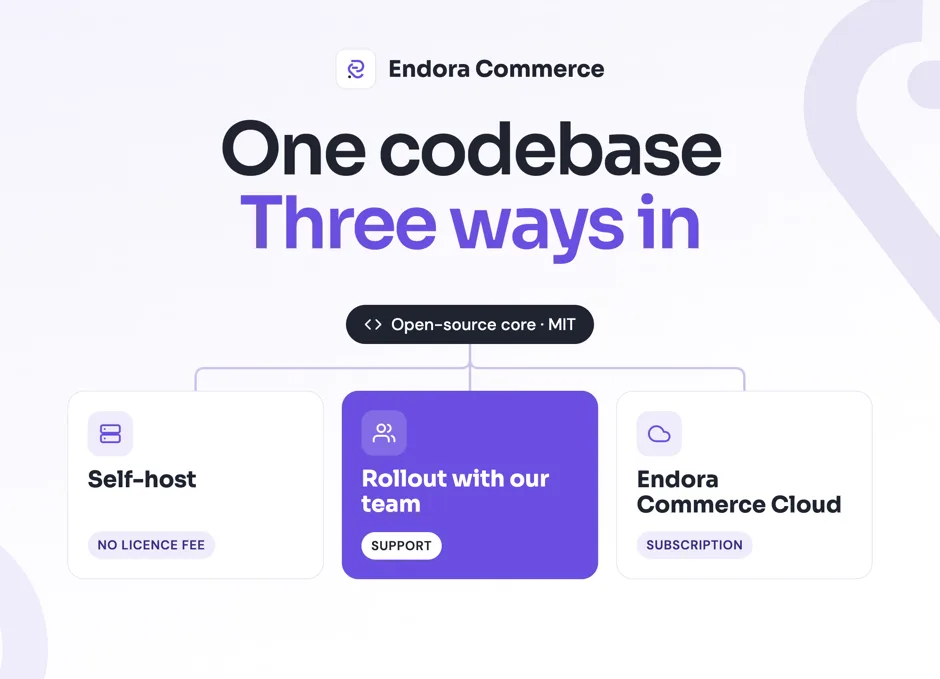
In short: Endora Commerce has one open codebase under the MIT licence and three ways to get started. Self-hosting suits companies with their own development team. A rollout with Endora’s team is the choice for companies that need ERP and PIM integrations and a platform fitted to their sales processes. Endora Commerce Cloud is for those who want to hand the technology over to a partner on a subscription. None of these decisions is permanent, because the code stays open whichever path you take.
The code is open. So how do you actually start?
Since Endora Commerce became available under the MIT licence, the question I hear most often from B2B leadership teams is this: “Fine, the code is open. So how do we actually get started?”. What the licence itself changes in your relationship with a vendor, I covered in the piece on what open code changes when choosing a B2B platform. Here I focus on the next step: choosing how to start.
At this stage the decision isn’t about technology. The platform core is the same for everyone. What you’re choosing is how to split responsibility, skills and costs between your company and a partner.
What should drive the choice?
In workshops with clients we usually work through four questions. The answers point to the right path faster than comparing feature lists.
- Who will maintain the platform? An in-house team that knows Node.js is a very different starting point from an IT department that looks after the ERP and the office network.
- How complex are the integrations? A store with a single price list is a different project from selling with customer-specific price lists, credit limits and stock from several warehouses that all have to match the ERP.
- Who should own the infrastructure? Servers, updates, backups and security are an ongoing cost and an ongoing responsibility, even when they don’t show up in the implementation budget.
- How do you budget? Some companies prefer a one-off investment and their own resources, others a predictable subscription. Both are sensible, as long as you see the total cost from day one, not just the cost of getting started.
When does self-hosting Endora Commerce make sense?
This path is for companies with their own development team. You run the platform core on your own servers and pay no licence fee. The open-source edition is a complete B2B store with an admin panel, and the requirements and installation guide are in the Endora Commerce documentation.
On the business side, be honest about what you’re taking on:
- Maintenance and updates: your team rolls out new core versions and keeps your own changes compatible.
- Security and infrastructure: servers, backups, monitoring and incident response.
- Integrations: ready-made connectors for ERP, PIM, payment gateways or carriers are paid modules. The layers they’re built on are part of the open code, so your team can write an adapter for the system you use.
Self-hosting makes sense when your sales platform is a strategic capability and you want to develop it at your own pace.
When should you go for a rollout with Endora’s team?
This is the path most of the mid-sized B2B companies I talk to choose. The reason is simple: the biggest risk in a B2B project rarely sits in the store itself. It usually sits in the data, the integrations and the processes that have picked up years of exceptions.
We start with a Discovery workshop where we take your sales process apart piece by piece. After about 4 weeks you have a working prototype on your own data, and together we decide on the full rollout. That’s when we connect the platform to your ERP, PIM, payments and carriers, migrate data and fit the processes. The stages are described on the page on how an Endora Commerce rollout works.
This is where integration experience pays off. We’ve been building B2B sales platforms for over 12 years, and on projects where the store constantly exchanges data with a PIM and an ERP, we know exactly what each mismatch costs: a price in the store that differs from the invoice, or a product shown as available online that’s no longer in the warehouse. That’s why we agree the data mapping in the workshop, not after launch.
On our rollouts, paid integration modules are part of the price agreed upfront. After launch, we can take over platform maintenance and development. You’ll find more about our approach to B2B sales platforms on the service page.
When is Endora Commerce Cloud the right fit?
It’s the same platform on a subscription, hosted by Endora. You don’t maintain infrastructure, plan updates or build hosting skills. You focus on sales, and the technology is on our side.
You’ll find the subscription plans and what each one covers, including which plan includes ERP, PIM, WMS and CRM integrations, on the Endora Commerce Cloud page. This path suits companies that want a predictable monthly cost and have no plans to build their own e-commerce team.
The three paths side by side
| Self-hosting | Rollout with Endora’s team | Endora Commerce Cloud | |
|---|---|---|---|
| Who it’s for | Companies with an in-house development team | Companies that need integrations and process fit | Companies that want to hand technology to a partner |
| Core licence | Free (MIT) | Free (MIT) | Included in the subscription |
| Integrations | Your own adapters or paid modules | Included in the agreed rollout price | In the Pro plan (ERP, PIM, WMS, CRM) |
| Infrastructure | On your side | Your server or Endora Commerce Cloud | On Endora’s side |
| Cost model | Your own team and servers | Implementation project | Monthly subscription |
How do you work out the total cost of each path?
When comparing paths, it’s easy to line up only the cost of getting started. For the full picture, work out the costs over at least 3 years:
- Self-hosting: developer salaries or hours, servers and monitoring, paid integration modules or the time to build your own adapters, plus the team’s time spent on updates.
- Rollout: the project price including integration modules, infrastructure (your own or Cloud), and a budget for maintenance and development after launch.
- Cloud: the subscription for the full contract period and any development work outside the plan.
The most expensive path usually turns out to be the one whose running costs nobody worked out before signing.
Is this choice permanent?
No, and I see that as the biggest business advantage of open code. With a closed platform, changing the way you work with a vendor usually means a migration and rebuilding everything from scratch. Here the code is yours whichever path you take, and on a rollout it lives in your own Git repository.
A company that starts on Cloud today can move to its own instance at any time, once it has built a team. That migration is a separately priced service, but it doesn’t mean rebuilding the platform from zero. A company that rolled out with us can take over development itself or choose a different technology partner.
FAQ
Is self-hosting Endora Commerce free?
The core licence is free. You pay for your own infrastructure, your team’s work and any ready-made integration modules.
Can I start on one path and switch later?
Yes. The code is open under the MIT licence, so changing the model doesn’t mean rebuilding the platform. Moving from Cloud to your own instance is possible at any time as a separately priced service.
Which path is the fastest?
With a rollout by our team, a working prototype on your own data is ready in about 4 weeks. The date of the full launch depends on the integration scope and the state of your data, so we set it after the prototype, in the roadmap.
Do I pay separately for integration modules on a rollout with Endora?
No. Paid modules are part of the agreed rollout price, not a separate line item after launch.
Not sure which path fits your company? Book a free consultation, and in a workshop we’ll work through it using your own sales processes.
Our services
Full-spectrum B2B e-commerce support
Keep reading
Recently published
Endora Commerce under the MIT licence: what open code changes when you choose a B2B platform
Endora Commerce is now open source under MIT. What it means for a B2B company: code ownership, paid modules, and self-hosting vs a rollout vs Cloud.
Read more
Why I Started the Manufaktura E-commerce Podcast
Michał Zabielski on how the Manufaktura E-commerce podcast started, who it's for, and what episodes you'll find. 22 episodes about building B2B platforms.
Read more
A B2B Sales Platform for Manufacturing: ERP, PIM and Online Sales in One Place
A B2B sales platform for manufacturing brings ERP, PIM and online sales into one process. See how industrial companies can sell online without data chaos.
Read more
Endora Commerce features: which modules a rollout starts with
How we match Endora Commerce modules to a B2B company’s processes: pricing, orders, warehouses and channels. The full catalog is on the product site.
Read more
Endora Commerce industries: how we match a rollout to your business
How we tailor an Endora Commerce rollout to the industry: manufacturing, technical distribution, wholesale, MRO, building materials and automotive parts.
Read more
A B2B Platform for Distributors: Pricing, RFQ and ERP Integration
A B2B platform for distributors differs from a standard online store: per-customer price lists, RFQ and ERP integration. See which features you actually need.
Read more
Software for the Automotive Industry: Website, B2B System and Rollout
Software and a website for the automotive industry are more than an e-commerce template. See how to order a B2B system for a dealer or parts distributor.
Read more
Endora Commerce integrations: how we plan ERP, payment and KSeF connections
How we plan Endora Commerce integrations with ERP, payments, KSeF and PIM in a B2B rollout. The current list of every connection is on the product site.
Read moreHave a specific challenge?
Don't just read about it - let's talk about your case.