
Selfie Jewellery: a store integrated with Polka ERP for online and boutique sales
A jewellery brand’s online store integrated with Polka ERP: products, prices and stock from the ERP, orders and customers from the store to the ERP. One data source for e‑commerce and boutiques.
- 5
- data areas synchronized with the ERP: products, prices, stock, orders and customers
- 22 mo.
- of store and integration development
- 660+
- changes delivered by the Endora team
- 5
- Endora people on the project
- Client
- Selfie Jewellery
- Industry
- Fashion and jewellery, online and in brick-and-mortar boutiques
- Scope
- Magento 2 store, Polka ERP integration (products, variants, prices, stock, orders, customers), catalog migration from the previous store, two-step checkout, boutique pickup, online payments, Magento upgrades
- Cooperation period
- June 2019 - April 2021
- Technologies used
- Magento (Adobe Commerce)PHPJavaScriptMySQL
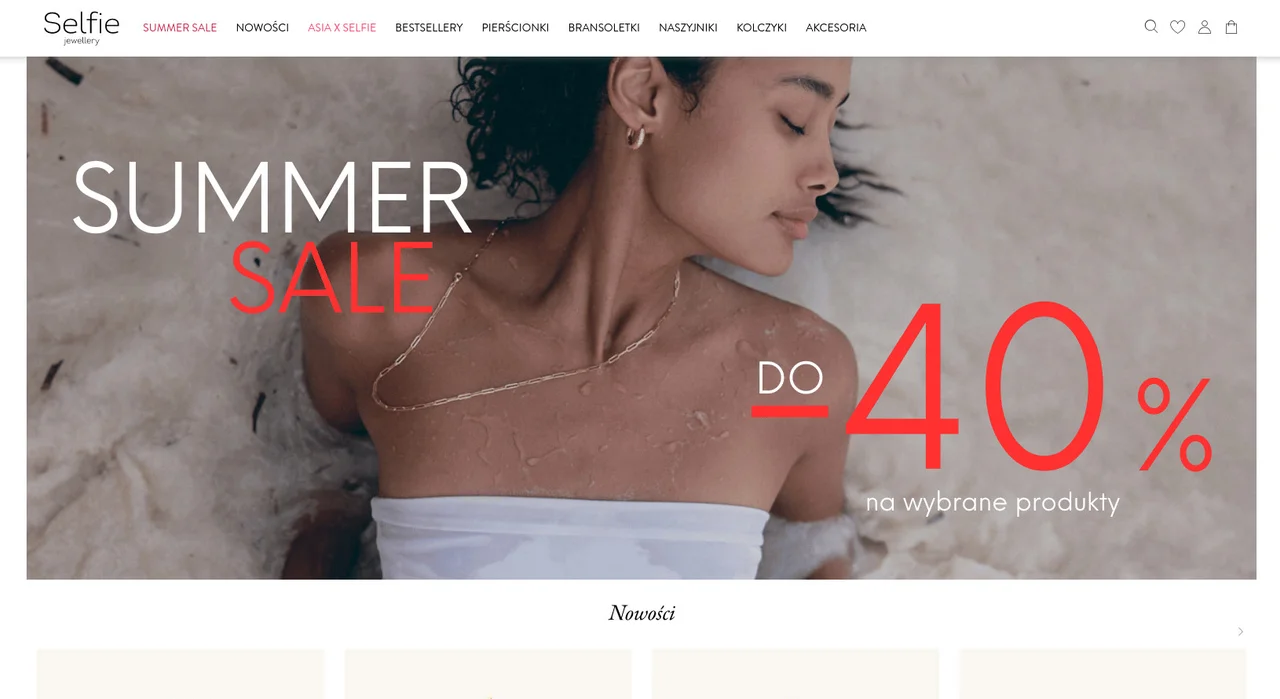
Selfie Jewellery is a Polish jewellery brand: bracelets, necklaces, rings and earrings, including personalized and made-to-order pieces. The brand sells online and in brick-and-mortar boutiques, and manages its range, prices and warehouse in Polka, an ERP system by ODL.
From June 2019 to April 2021 we developed the Selfie store on Magento 2. The key task was connecting it to the ERP so that online and offline sales used the same data: the Selfie team enters a product, price or promotion once, and an online order immediately lands where sales are handled.
The ERP as the single source of truth
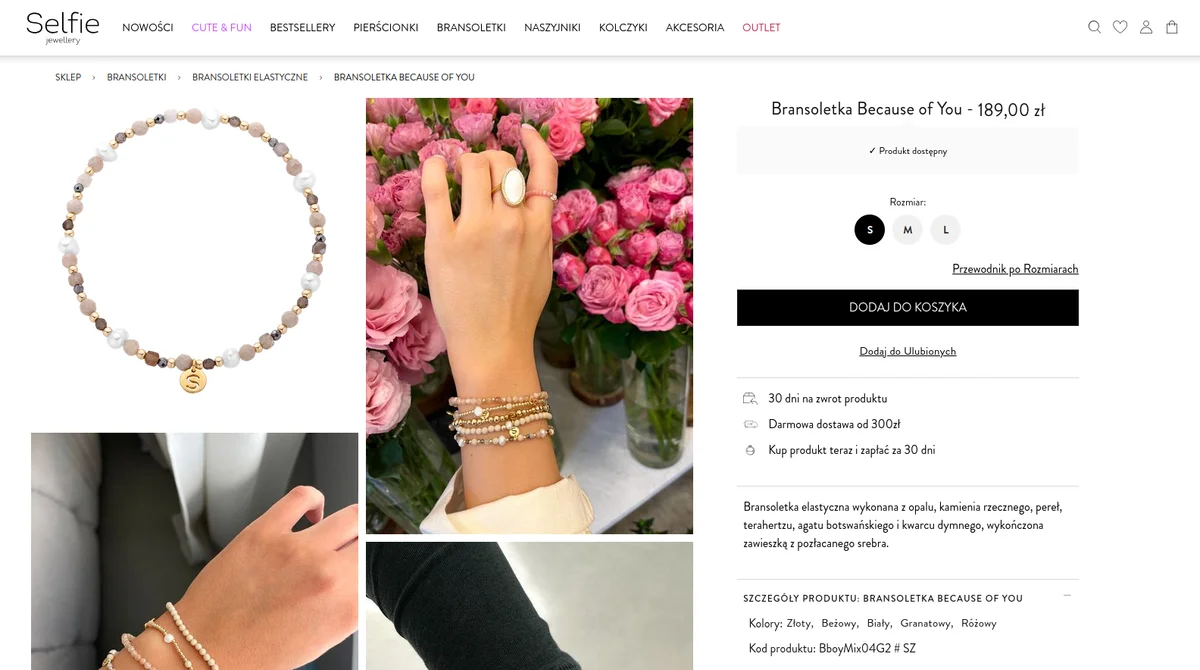
The Selfie team works in the ERP: new products are created there, prices change there and stock is visible there. We wrote a custom Magento module that fetches products, prices and stock from the ERP on a schedule. A new product appears in the store on its own, a price change does not require logging into the store admin, and a product that is out of stock stops being available online.
Sized jewellery, such as bracelets in S, M and L, arrives from the ERP as separate variants. The module combines them into one product page with a size picker and tracks the stock of each variant separately. Products Selfie makes to order have a separate flag in the ERP: the store lets customers buy them even at zero stock, because the order starts production.
For the business this means less work with every new collection and fewer situations where a customer buys a product that is no longer there.
Orders and customers reach the ERP on their own
Once an order is placed, the store sends it to the ERP as a document with items, discounts, shipping cost and address. The gift card amount is spread across the items as a discount, so the values in the ERP match what the customer paid. Order status changes in the store are passed to the ERP, and the Magento admin shows whether an order is already in the ERP and under which document number. Orders and customers can also be synchronized manually with one button.
The integration is resilient to outages. An order first goes into a queue, and if the ERP is briefly unavailable, the store retries in the following cycles, up to five times, and logs the error. No order gets lost because a system was briefly down.
Customers who register in the store are created in the ERP, and a customer who already exists in the ERP, for example from boutique purchases, is recognized by email address instead of being duplicated.
Online sales that lead to the boutique
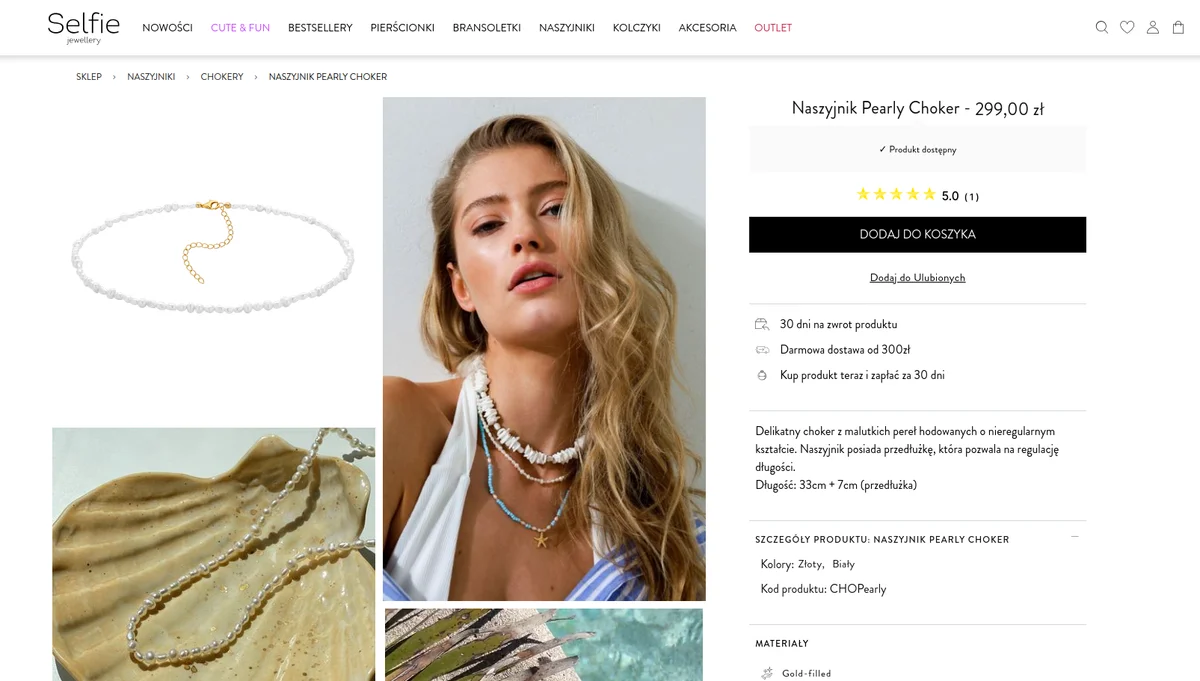
Customers can order jewellery online and collect it in a chosen boutique, with no shipping cost. The boutique name is added to the order, so the team knows where to prepare it. Stock from the ERP is shared by both channels, so what a customer sees as available online matches what is in the warehouse.
We also rebuilt the order process into two steps: log in or shop as a guest, then shipping and payment on one screen with a cart summary.
Migration without losing content
Before the integration, the Selfie catalog came from a previous e‑commerce platform. We moved its products with descriptions, photos and category assignments, and the integration module merges them with ERP products instead of creating duplicates. A product with variants from the ERP takes over the product page moved from the previous store, together with its content and address.
Technology in the background
The store runs on Magento 2. We built the Polka ERP integration as a custom module: an ERP API client, cron jobs for products, prices and stock, an order queue with retries, customer and status synchronization, and separate logs for each area. Every change reached the test and production environments through CI/CD. Want to connect your store to the ERP you use for in-store sales? See how we handle ERP and PIM implementations and integrations, or let’s talk about your project.
Business challenge
What needed solving?
Two channels, one range
The same jewellery sells in boutiques and online. Online customers need to see current availability, and a boutique must not sell a product someone has just bought online.
Retyping data by hand
New products, prices and promotions were created in the ERP. Without an integration every change had to be repeated in the store, and every online order retyped into the ERP.
Variants and made-to-order products
Bracelets and rings come in sizes, and some jewellery is only made once ordered. The store had to understand that instead of showing such products as unavailable.
A catalog from the previous store
Descriptions, photos and categories from the previous platform could not be lost when switching to ERP data.
Solution
A store and an ERP that speak with one voice
Products and variants from the ERP
New products from the ERP appear in the store on their own, and products with sizes become one product page with a variant picker. Products marked in the ERP as hidden online stay out of the store.
Prices and stock without manual work
Prices and stock levels of products and variants are fetched from the ERP on a schedule. The ERP is the single source of truth about what is available.
Made to order
A product marked in the ERP as producible can be bought even at zero stock, so the store does not lose sales of made-to-order jewellery.
Orders and customers to the ERP
A store order reaches the ERP with its items, discounts, gift cards, shipping cost and address. A new store customer is created in the ERP, and an existing one is recognized by email address.
Boutique pickup
At checkout the customer picks the boutique where they will collect the order, with no shipping cost. An online order brings the customer to a physical store.
Two-step checkout
Log in or shop as a guest, then shipping and payment on one screen with a cart summary. Fewer steps between the cart and a paid order.
How we worked
From the store launch to the ERP as the single source of truth
- 01
Launch on Magento 2
In summer 2019 we set up the store on Magento 2: theme, currencies and languages, payments, gift cards and dozens of improvements to the category view, product page and cart.
- 02
Integration foundation
In early 2020 we built the Polka ERP API client and upgraded Magento to 2.3.4, so the integration was built on a current platform.
- 03
Checkout and boutique pickup
In summer 2020 we rebuilt the order process into two steps and added personal pickup in a chosen boutique.
- 04
Catalog migration and variants
In autumn 2020 and winter 2021 we merged the products moved from the previous store with ERP products, keeping descriptions, photos and categories, and handled variants and made-to-order products.
- 05
The ERP takes over stock and orders
In spring 2021 the ERP became the single source of stock levels, and orders gained status change synchronization and manual sending from the admin panel.
Results
What did Selfie Jewellery gain?
- ✓ One range, prices and availability for the online store and the boutiques, managed in one place: the ERP
- ✓ No more retyping orders and customers from the store into the ERP
- ✓ Fewer sales of products that are gone, because stock comes from the ERP
- ✓ Made-to-order jewellery and sized products sell online just like in a boutique
- ✓ Online orders with boutique pickup that connect online and in-store sales
- ✓ A resilient integration: when the ERP is briefly unavailable, the order waits in a queue and is sent again
See next
More case studies
New sales platform
Endora Commerce: 12 years of B2B rollouts in one platform
How the Endora core team turned 120+ B2B rollouts into Endora Commerce: open source under the MIT licence, 80 modules and a live demo you can test.

Platform migration
DKM Power Transmission. Sales Platform
From an unstable platform and abandoned carts to a 2 pp conversion increase.
Have a specific challenge?
Don't just read about it - let's talk about your case.