
Labelcall: e‑commerce platform integrations and a customer panel for Business Caller ID
Plugins and apps for Shopify, WooCommerce, Magento 1 and 2 and Pipedrive, a customer panel with subscriptions, and .NET backend development for the Business Caller ID app.
- 5
- integrations: Shopify, WooCommerce, Magento 1 and 2, Pipedrive
- 4 years
- of cooperation: from the first plugin through development and maintenance
- 126
- merge requests merged in the backend, panel and plugins
- 10
- Endora people on the project
- Client
- Labelcall
- Industry
- SaaS: a Business Caller ID mobile app for online stores and businesses
- Scope
- Business consulting, store platform and CRM integrations, customer panel, subscriptions and payments, .NET API development for the panel and the mobile app, maintenance and development
- Cooperation period
- October 2017 - October 2021
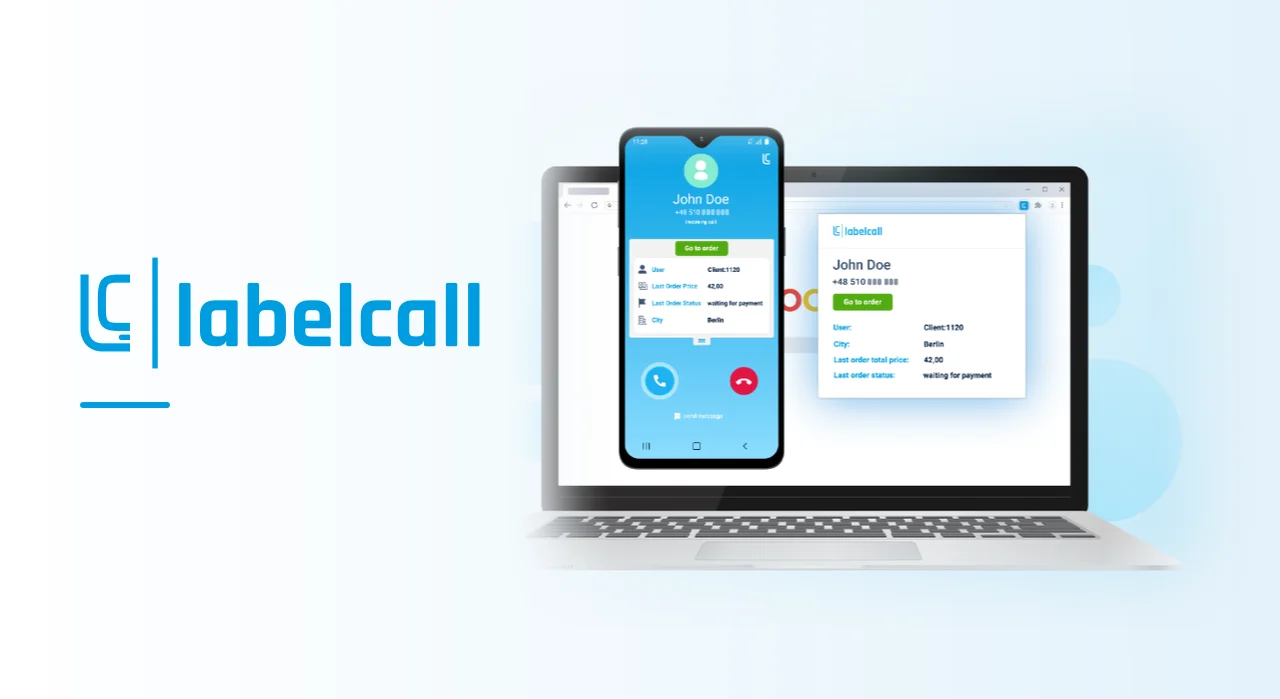
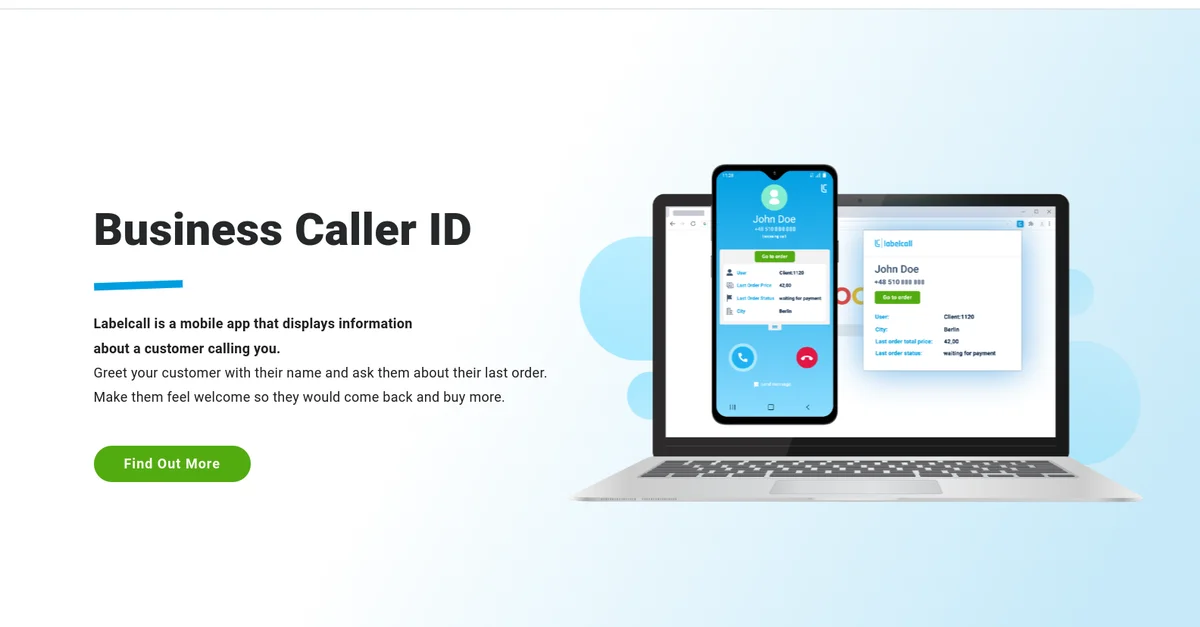
Labelcall is a Business Caller ID mobile app. When a customer calls a business, the app shows on the phone screen who they are, what they bought last, how much they spent and the status of their order. The seller can greet the customer by name and answer a question about the parcel before it is even asked.
For this to work, Labelcall needs data from a store or a CRM. The client wanted to take the product to the e‑commerce market but had no experience there, so they came to us with two questions: which platforms to integrate with, and what to change in the product so it works with stores. The cooperation ran from October 2017 to October 2021. We did not build the mobile app itself: we delivered the features and methods it needed in the backend.
Consulting: which platforms to choose
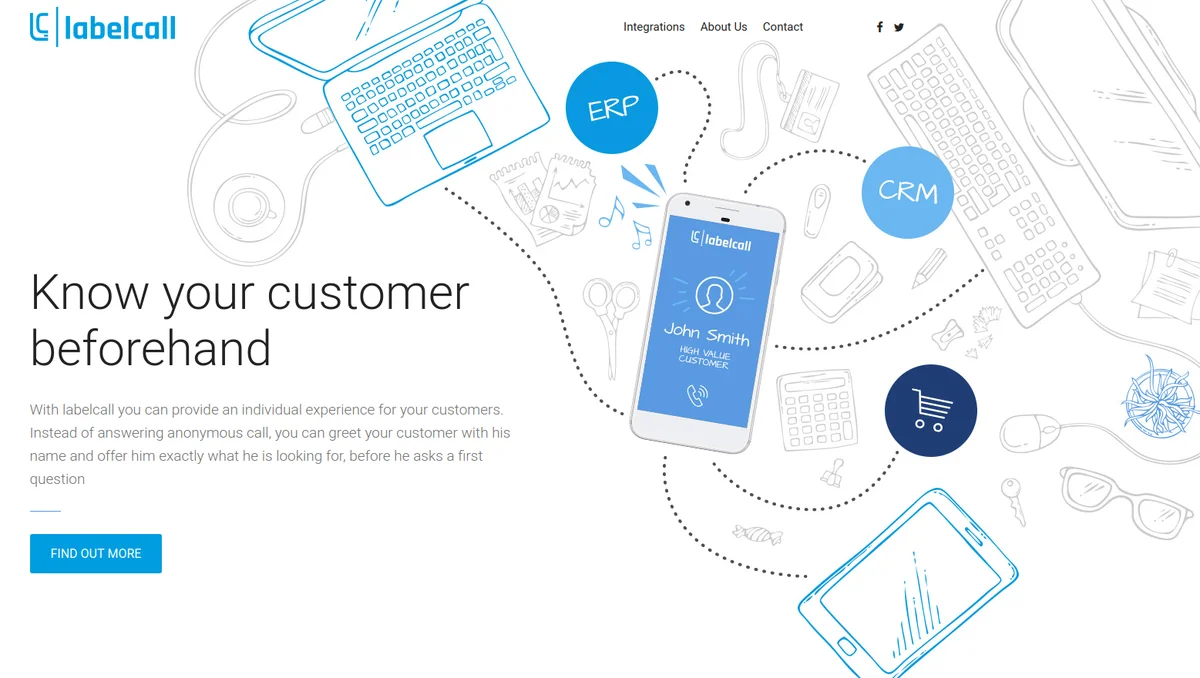
We started with a market analysis. We chose Shopify, WooCommerce and Magento as platforms that together give access to a large share of online stores, plus Pipedrive as a CRM for companies that sell through sales reps. We also pointed out what to change in the existing product so it would work efficiently with stores.
For the business this meant Labelcall did not have to learn the e‑commerce industry on its own before releasing its first integration.
Store plugins: WooCommerce, Magento 1 and 2
The PHP plugins for WooCommerce and Magento 1 and 2 install in a store like any other extension. We developed the WooCommerce plugin the most. In it, the store owner goes through a wizard: enters the phone number the app should work on, chooses which customer details to show and sets their order. The plugin transfers existing customers to Labelcall with a progress bar and then sends changes to contacts and orders as they happen. It supports several phone numbers and devices, as well as language versions.
Later, the WooCommerce plugin moved to the shared configurator in the panel, got new data such as average order value and the number of products in the cart, and the fixes required by the plugin review. For the business this means the seller sees not just a name on a call, but also how valuable the customer is to the store.
Shopify and Pipedrive
We built the Shopify app from scratch. Customer sync runs in the background and fetches data in batches of 250 records, so installing it in a large store does not block the app. The app handles the GDPR webhooks Shopify requires, uninstalling and reinstalling, and after installation the store owner gets a confirmation e-mail. The field list gained, among others, the customer number and details of the last order.
The Pipedrive integration started as a separate NestJS service: app installation via OAuth and webhooks with contact changes. We then moved its logic into the .NET backend so that all integrations work in one place. We took over and maintained the integration with Shoper, a Polish platform.
Customer panel: one configurator for all platforms
The most important change to the product was the Vue.js customer panel. Before, configuration lived in each plugin separately. Now every integration opens the same wizard in the panel: the owner creates an account, chooses the customer details to show and adds devices. In the panel they also manage integrations, API keys, their profile, plan, payments and invoices.
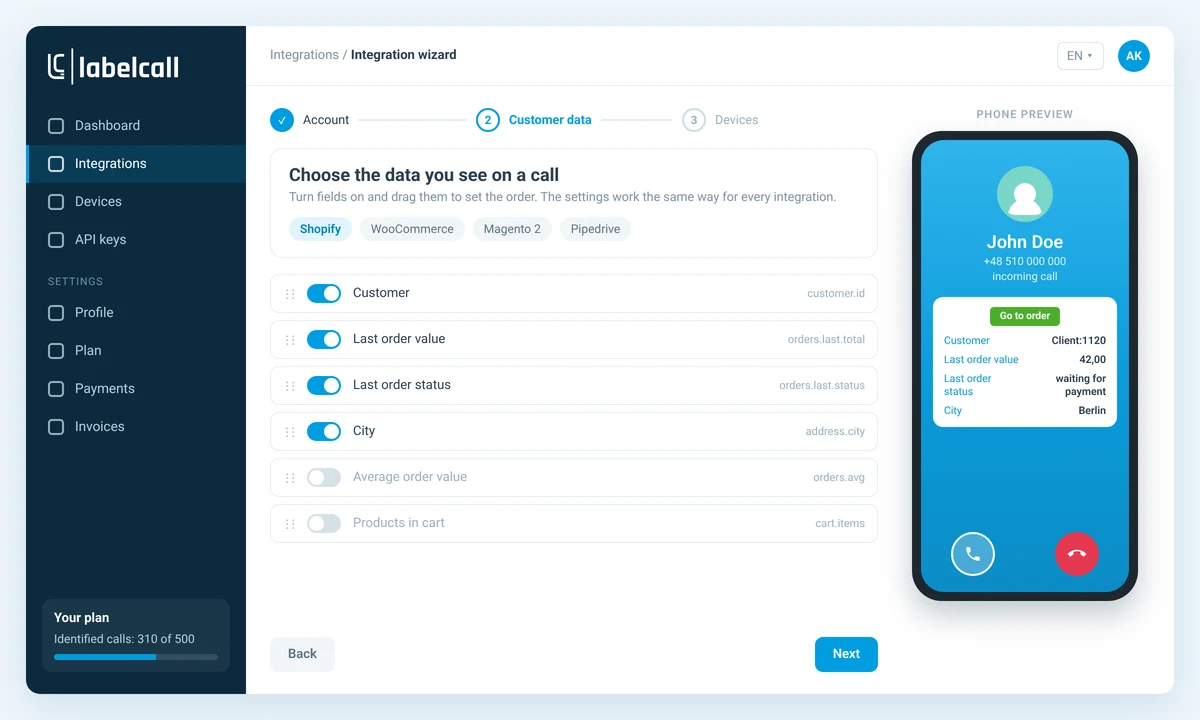
The illustration shows the layout of the panel and the wizard based on its code. Customer data, plan and figures are examples.
For the business this means Labelcall ships a new feature once, in the panel and backend, and it reaches all platforms at once. Without it, every change would need a separate version of four plugins.
Subscriptions and payments
Labelcall sells access in subscription plans. We built the full payment process on Stripe: choosing a plan, card payment, recurring payments, card management, payment history, invoices and subscription cancellation. The backend counts identified calls against the plan’s limit and sends daily e-mails about subscriptions that are about to end.
For the business this means sales without the team’s involvement: the customer signs up, pays and starts using the product on their own.
.NET backend: takeover, development and maintenance
Labelcall’s backend is a set of .NET services in containers on Microsoft Azure: an API gateway, an identity service, a core with contacts and devices, and services for individual integrations. We took it over from the previous team in December 2019. We added Swagger API documentation, an endpoint that accepts contacts in batches instead of one by one, sign-up, password reset, profile and contact form handling, and the methods the mobile app needed, such as the list of fields to show during a call.
For the business this means the backend was ready for large volumes of contacts from stores, and the mobile app could use new data without being rebuilt.
Technology in the background
The backend runs on .NET with an Ocelot gateway, an identity service, Cosmos DB and Event Grid on Microsoft Azure. The customer panel is a Vue.js application in TypeScript, and the Shopify app’s interface was built in React. The plugins for WooCommerce and Magento 1 and 2 are written in PHP. Between 2017 and 2021, 10 Endora people worked on the project, with 561 commits across four repositories. Want to connect your product with store platforms? See how we build platform integrations and automations, or let’s talk about your project.
Business challenge
What needed solving?
A new market without experience
Labelcall wanted to reach online stores but did not know the e‑commerce industry. It needed a partner to help choose the platforms that give access to the largest share of the market.
Customer data in other systems
The app shows details of the calling customer, but that data lives in the store or the CRM. Each platform has a different API, a different customer and order model and different rules for publishing extensions.
Many platforms, one product
Labelcall’s configuration could not be written separately in every plugin. New features had to reach all platforms at once.
Sales and billing
The product needed a self-service panel: sign-up, devices, API keys, subscription plans, card payments and invoices.
Solution
Integrations, panel and backend as one system
Advice on choosing platforms
Together with the client we chose Shopify, WooCommerce, Magento and Pipedrive CRM as the platforms that give access to a large share of the market, and pointed out what to change in the product.
Store plugins
PHP plugins for WooCommerce and Magento 1 and 2 send customer and order data to Labelcall, and WooCommerce also transfers customers from before installation.
Shopify app and Pipedrive
We built a new Shopify app from scratch, with background sync and the GDPR webhooks, and an integration with Pipedrive CRM. We took over and maintained the Shoper integration.
Customer panel with one configurator
A Vue.js panel with a wizard where the store owner chooses which customer details they see on the phone. The wizard works the same way for every platform.
Subscriptions and payments
Subscription plans, Stripe recurring payments, cards, payment history, invoices, subscription cancellation and limits on identified calls.
.NET backend and API
We took over, extended and maintained the .NET backend on Azure: an API for the panel, the plugins and the mobile app, documented in Swagger.
How we worked
From the first plugin to a platform with subscriptions
- 01
Choosing platforms and the first plugin (October 2017 - April 2018)
After analysing the market we started with WooCommerce: a configuration wizard, choosing and ordering customer fields, migrating existing customers with a progress bar, phone number validation, multiple devices and translations.
- 02
Concept, architecture and taking over the .NET backend (2018 - February 2020)
After the first plugin we worked on the concept and architecture for the product’s further development. In December 2019 we took over backend development from the previous team: we added Swagger API documentation, moved Shopify sync to background jobs, added the GDPR webhooks and an endpoint that accepts contacts in batches.
- 03
Customer panel and subscriptions (March - July 2020)
A Vue.js panel: integration wizard, devices, API keys, profile, plan, payments, billing details and invoices. In the backend: Stripe, recurring payments, call limits and subscription-ending e-mails.
- 04
Pipedrive and the new Shopify app (2020)
The Pipedrive integration started as a separate NestJS service, and we then moved it into the .NET backend. The Shopify app got a wizard opened from the store admin and new customer and order data.
- 05
New WooCommerce version and maintenance (October 2020 - October 2021)
The WooCommerce plugin moved to the shared configurator, got new data such as average order value and products in the cart, and fixes from the plugin review. In parallel we handled production issues.
Results
What did Labelcall gain?
- ✓ A successful entry into the e‑commerce platform market with integrations for Shopify, WooCommerce, Magento 1 and 2 and Pipedrive
- ✓ A market validated through the fast delivery of an MVP, with tested business hypotheses setting a new direction for the product
- ✓ One configurator in the panel: a new feature reaches all platforms at once, without changing each plugin separately
- ✓ Self-service sales: sign-up, plans, card payments and invoices without involving the Labelcall team
- ✓ A foundation for the next direction of product development: browser extensions
See next
More case studies
New sales platform
Endora Commerce: 12 years of B2B rollouts in one platform
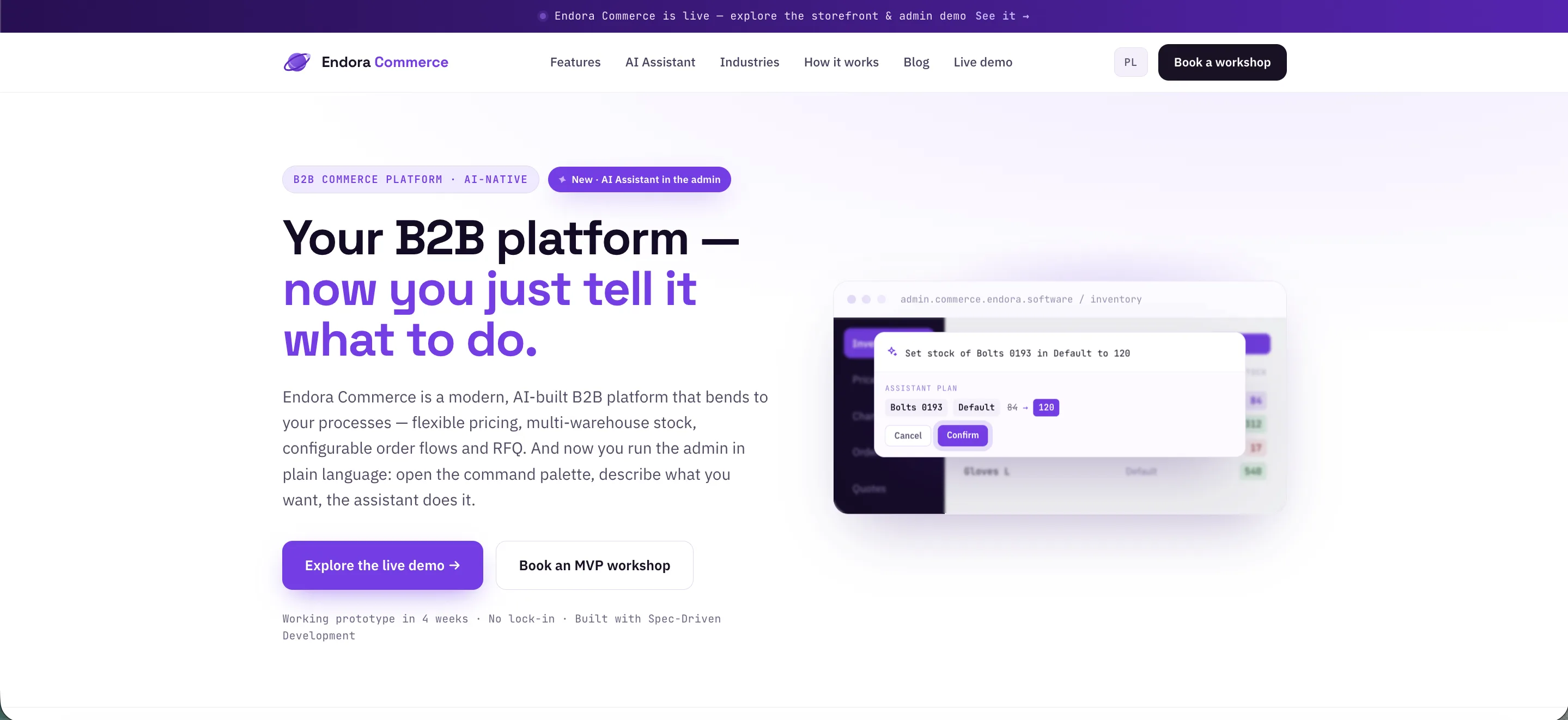
How the Endora core team turned 120+ B2B rollouts into Endora Commerce: open source under the MIT licence, 80 modules and a live demo you can test.

Platform migration
DKM Power Transmission. Sales Platform
From an unstable platform and abandoned carts to a 2 pp conversion increase.
Have a specific challenge?
Don't just read about it - let's talk about your case.