
SEO for B2B. How to Position Your B2B E-commerce Platform

Author: Traffic Trends
· 8min read

Traditional B2B SEO, writing long articles to chase mass traffic, has stopped delivering results. In the era of Google AI Overviews and chatbots, business buyers search in a completely different way, and both Google’s algorithms and language models effectively filter out repetitive, low-value content. Learn how to build a B2B platform positioning strategy that survives the AI revolution and reaches people with real budgets.
How AI and Google AI Overviews (AIO) Have Changed the Rules of B2B Positioning
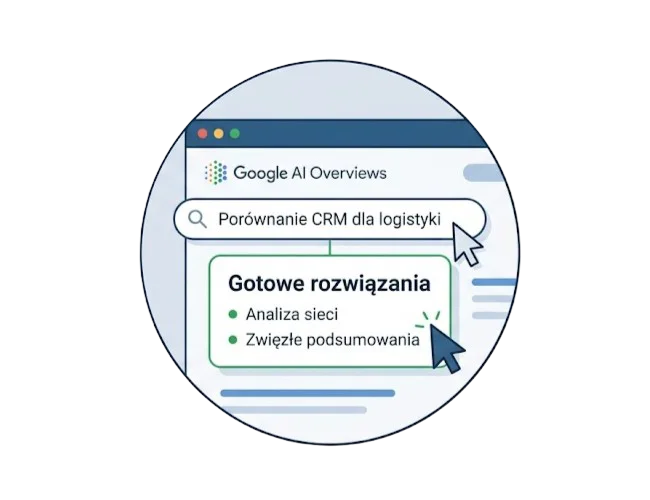
The introduction of Google AI Overviews (AIO) means the search engine is no longer just a middleman pointing to websites, it has taken on the role of an assistant that serves ready-made answers. For B2B e-commerce platforms, this is a fundamental shift. Business buyers no longer need to click through multiple articles to compare software features or implementation stages; AI does it for them, generating concise summaries at the top of search results. Competing for a single keyword position is no longer enough, for a B2B brand to remain visible, it must feed algorithms with unique, substantive content.
Intent-Based Content Strategy. How to Reach People With Budgets
Most B2B platform positioning failures do not stem from poor writing quality, but from incorrect targeting. Now that general informational traffic from search engines is dropping sharply, Intent-Led Content, a content strategy based on purchase intent, has become the key to success. People with budgets rarely type simple, one- or two-word phrases into a search engine. Their queries are precise, deep, and often stem from a specific moment in the business process they find themselves in. Modern B2B SEO means cutting everything generic and focusing 100% of your energy on creating materials that respond to real purchase intent.
Recommendations from Traffic Trends:
- Change your keyword selection criteria, reject search volume as the primary factor and focus on query precision instead.
- Build a map of business customer questions based on real conversations from your sales and technical support teams.
The End of Generic Phrases. Time for Keywords That Actually Sell
The key to B2B e-commerce platform success is shifting the focus to High-Intent Keywords, phrases typed by people ready to engage. Instead of generic terms, your platform structure must target precise product and comparison queries, as illustrated in the table below:
| Phrase type | Example query | Who types this? (intent) | Business value | What does AI do with it? |
|---|---|---|---|---|
| Generic / Definitional | ”copper properties” | Student, intern, someone looking for free theory | Near zero (no conversions, empty stats) | AI provides the definition on screen; the user does not click any link. |
| High-Intent | ”copper cable YKY 5x10 wholesale price list” | Manager, director with a budget and a real problem | Very high (readiness to buy / contact) | AI looks for precise comparisons and recommendations, your content must be there. |
Recommendations from Traffic Trends:
- Create “Alternative to…” or “Comparison with…” subpages, positioning yourself on queries from customers looking for substitutes for your competitors.
- Disclose your pricing or describe your billing model, create a page dedicated to implementation costs, as this is one of the highest-converting phrases.
- Optimise landing pages for niche long-tail phrases combining your offer with a specific industry (e.g. “CRM for logistics”).
Creating Content That Answers the Precise Questions Asked to AI and Google AI Overviews
A business buyer will no longer simply type “cloud migration costs”, they will ask: “How do I safely move company data from cloud X to Y without team downtime?” For your content to appear in search results and be pulled by Google AI Overviews as a source, you need to adapt the structure of your texts to this conversational style. Review the headings and FAQ sections in your articles and phrase them exactly the way managers ask complex questions. Instead of the subheading “Migration Security”, use the heading: “How to Avoid Data Loss During System Migration?” When your page answers such precisely formulated questions directly, algorithms will have no trouble matching your article as the ideal answer to complex user problems.
Recommendations from Traffic Trends:
- Use tools like AnswerThePublic to find out what specific questions people ask in the context of your services.
- Introduce FAQ sections on subpages where, directly under an H3 heading, there is a specific 2–3 sentence answer, ideal for an algorithm to extract.
Restructuring content for AI algorithms requires a precise audit and a new approach to semantics. You don’t have to guess what your customers are asking.
At Traffic Trends we will prepare a free B2B SEO Strategy consultation for you, in which we will analyse your platform’s visibility in terms of AIO and point out ready-made solutions that will help you get ahead of the competition.
Unique Value Instead of Recycled Schemas. How to Beat the Algorithm
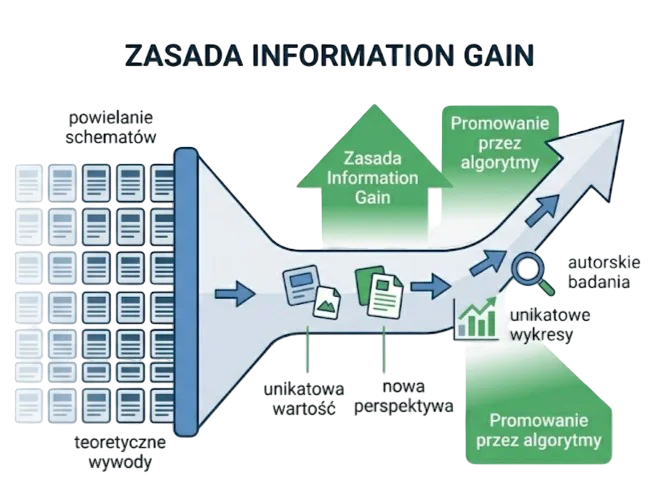
The method of scanning the TOP 10, mixing competitors’ conclusions and publishing a slightly longer article has simply stopped working. Today’s algorithms are focused exclusively on detecting and promoting original content. The key to survival and visibility is the Information Gain principle. Google officially rewards and promotes sources that bring new, previously unseen value to the web, new perspectives, previously unpublished data, or unconventional solutions to known problems. To beat the algorithm in the B2B sector, you must stop repeating commonly available information. Your site must become a primary source of knowledge that others, including AI models, will want to reference. This is the best way to implement Google’s E-E-A-T guidelines, which build domain authority and protect the site from filters targeting mass AI content.
Why Copying Competitors Has Stopped Working. Implementing the Information Gain Principle in Practice
Implementing the Information Gain principle in day-to-day content work requires abandoning the practice of copying structures from the TOP 10, if you repeat competitors’ patterns when creating content, the algorithm will classify it as secondary content with low value. Here is what the shift to a model promoting unique knowledge and market experience looks like in practice:
| Content strategy feature | Old-school SEO (digital recycling) | Modern B2B SEO (Information Gain principle) |
|---|---|---|
| Approach to competition | Analysing TOP 10 and mixing their conclusions into a slightly longer article. | Ignoring repetitive patterns; searching for the information gap. |
| Knowledge source | Theoretical arguments generated en masse by AI. | Original research, case studies, unique charts, quotes from internal experts. |
| Main KPI | Mass traffic from generic and advisory phrases. | Purchase intent, brand trust and real conversions. |
| Algorithm response | Filtered out as low-value, secondary content. | Promoted with top positions in organic results and AI Overviews responses. |
A New Direction in B2B Positioning
SEO strategy in the B2B sector has evolved, building trust and a strong B2B brand position have moved to the forefront, although the technical foundation (clean code, speed and structured data) remains essential for AI models to correctly interpret the expert knowledge of your B2B e-commerce platform. The development of Google AI Overviews and zero-click searches does not mean the end of SEO; algorithms and chatbots will not replace substantive information, they search for it in order to deliver reliable answers to users. B2B platforms that focus on original expertise, precisely matching purchase intent and proving their value to both human decision-makers and learning algorithms through unique business experience, are the ones that win.
Want your B2B platform to dominate Google and AI Overviews results?
Theory is one thing, but implementing the Intent-Led Content strategy and the Information Gain principle requires experience. Don’t waste your budget on “old SEO” and generating empty traffic. Invest in activities that actually sell.
Apply for a free SEO & AI strategy consultation with Traffic Trends experts and receive:
- High-Intent phrase analysis, we will identify keywords with purchase potential.
- AI verification, we will assess whether your current content has a chance of ranking in Google AI Overviews.
- Action plan, specific, ready-to-implement recommendations for your B2B e-commerce.
FAQ. Frequently Asked Questions
What is Intent-Led Content and how do you apply this strategy?
Intent-Led Content is a content creation strategy based on the precise purchase intent of a narrow target audience, people who are looking for an optimal business solution and have a budget to spend.
What are High-Intent Keywords in the B2B sector?
High-Intent Keywords are keywords with high purchase intent, typed by a user who is ready to make a decision and buy. Examples include precise product queries, comparison listings and alternatives to competitors.
What is the Information Gain principle and why does Google promote it?
The Information Gain principle involves bringing new, previously unseen substantive value to the web. Google officially rewards sources that provide fresh perspectives, original research, unpublished data or unconventional solutions, while reducing the visibility of pages that recycle secondary content.
Our services
Full-spectrum B2B e-commerce support
Keep reading
Recently published

Why I Started the Manufaktura E-commerce Podcast
Michał Zabielski on how the Manufaktura E-commerce podcast started, who it's for, and what episodes you'll find. 22 episodes about building B2B platforms.
Read more
A B2B Sales Platform for Manufacturing: ERP, PIM and Online Sales in One Place
A B2B sales platform for manufacturing brings ERP, PIM and online sales into one process. See how industrial companies can sell online without data chaos.
Read more
Endora Commerce Features: an Overview of the Whole B2B Platform
A complete overview of Endora Commerce features across 10 areas: sales, catalog, pricing, warehouse, channels, AI and more. See what the B2B platform does.
Read more
Endora Commerce Industries: an Overview of 6 B2B Sectors
Endora Commerce for 6 B2B industries: manufacturing, technical distribution, wholesale, MRO, building materials, automotive parts. Which profile fits your business?
Read more
A B2B Platform for Distributors: Pricing, RFQ and ERP Integration
A B2B platform for distributors differs from a standard online store: per-customer price lists, RFQ and ERP integration. See which features you actually need.
Read more
Software for the Automotive Industry: Website, B2B System and Rollout
Software and a website for the automotive industry are more than an e-commerce template. See how to order a B2B system for a dealer or parts distributor.
Read more
Endora Commerce integrations: an overview of all 23 connections to external systems
23 Endora Commerce integrations in one place: payments, ERP, KSeF, AI, analytics and infrastructure. Find out what connects to your stack.
Read more
Endora Commerce vs other B2B platforms: comparing 12 e-commerce systems
12 comparisons of Endora Commerce against Shopify, Magento, WooCommerce and other B2B platforms in one place. Find the system that fits your business.
Read moreHave a specific challenge?
Don't just read about it - let's talk about your case.