
AR and VR in e-commerce: how a 3D configurator changes product sales

Author: Justyna Brończyk
Key Projects Lead
· 6min read
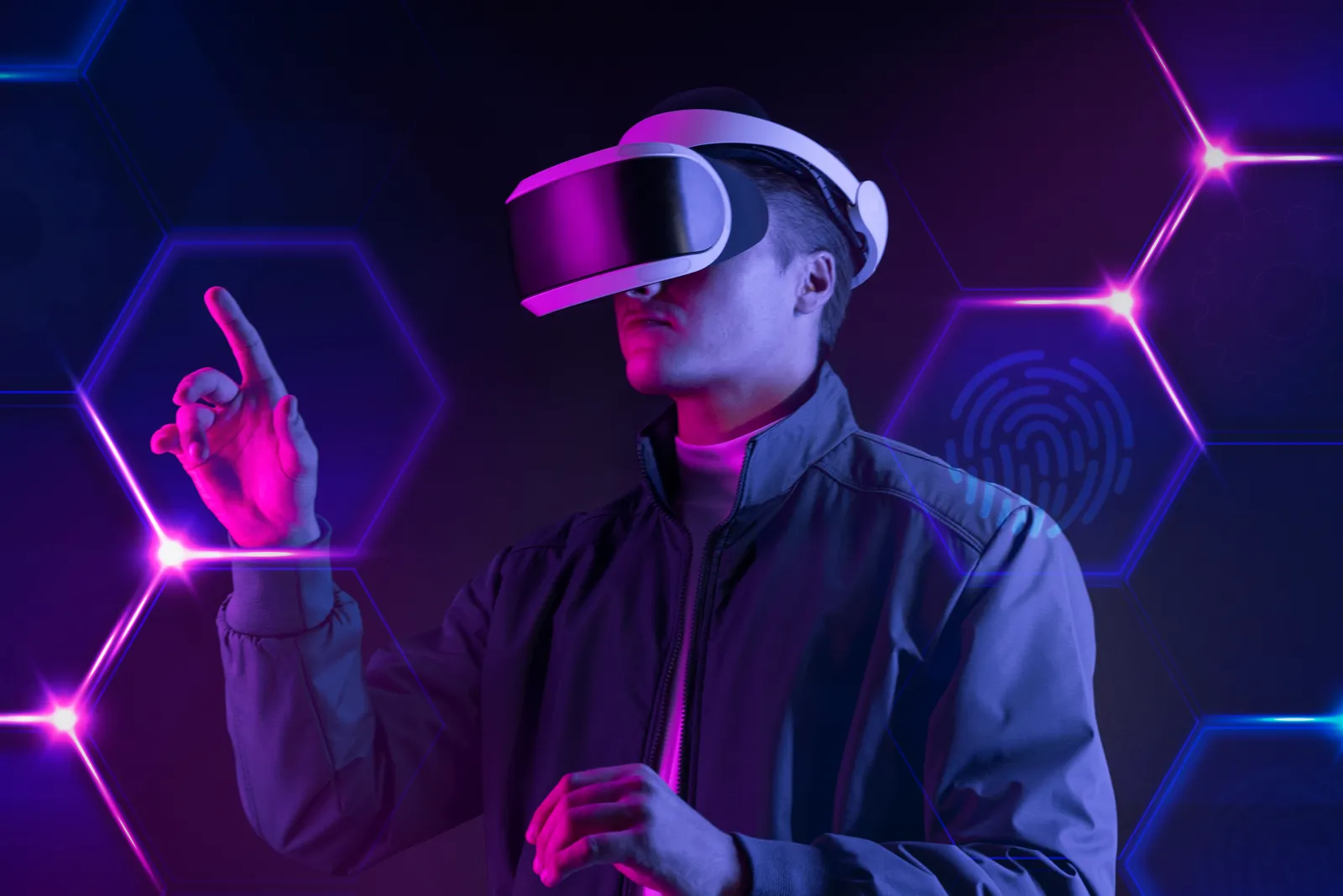
Buyers increasingly refuse to purchase a product they cannot see in their own space. This is especially true in categories where appearance, size, and fit matter: furniture, lighting, fixtures, interior finishes, clothing, eyewear. Augmented reality (AR) and virtual reality (VR) turn that problem from “sell me a visualisation” into “let me see the product in my home before I order.”
What AR and VR mean in a sales context
Augmented Reality overlays digital objects onto the camera feed of a device. A customer opens the camera on their phone, looks at the wall of their living room, and sees how a specific sofa would look there. Nothing to download, nothing to install, if the solution is built on WebXR and runs directly in the browser.
Virtual Reality puts the user into a fully virtual environment. It is used less often than AR in commerce because it requires dedicated headsets. It performs strongly in training, industrial simulations, and trade show presentations, where full immersion adds real value.
The practical difference: AR can be deployed today inside an existing online store and reach anyone with a smartphone. VR requires more investment in hardware on the recipient’s side but delivers a different quality of experience.
An AR configurator in practice: what we built for a furniture brand
One of our projects is a furniture configurator with a built-in augmented reality module, built on the Magento platform. The client is a furniture marketplace planning expansion into the US market, and they needed a differentiator, not another product photo gallery.
We built two integrated modules: one for assigning 3D models to products, another handling interdependent modifications of furniture elements (dimensions, colours, configurations). The whole thing is tied to Magento’s Custom Options mechanism and integrated with WebXR for AR preview in the buyer’s own room.
The project took six months to MVP, involved five people, and covered the import of one hundred 3D models. The client presented the solution at an industry trade show in the US and found new business partners. Importantly, the solution is generic: the same configurator handles windows, lighting, and other products that can be represented as 3D models, not only furniture.
The full project description is in the AR furniture configurator case study.
Technologies used to build AR and VR solutions
The choice of technology stack depends on where the application needs to run and what level of immersion is expected.
WebXR and Three.js is the approach that delivers the widest reach: the application runs directly in the browser without downloading anything. Three.js handles 3D model rendering, WebXR provides integration with the device camera and sensors. This is what we used in the furniture configurator.
React and React Native are the starting point when AR needs to be part of a mobile application or integrated with an existing e-commerce frontend. React Native reaches iOS and Android users from a single codebase and integrates with native AR APIs: ARKit on Apple and ARCore on Android. How we work with React and React Native is described on the technology pages.
ARKit (Apple) and ARCore (Google) are the native frameworks that deliver the best spatial tracking and visual results on smartphones. They require separate builds for iOS and Android, so they are chosen when experience quality matters more than reach.
3D engines (Unity, Unreal Engine) come into the picture for VR solutions and advanced AR applications that need a full virtual environment, physics, or complex animation. These are the tools for projects where the experience needs to be at the level of a game, not a web product.
Where AR and VR make business sense
The fastest return on investment appears in a few specific areas.
Product configurators are the largest and most mature market for AR in retail. Furniture, windows, doors, lighting, bathrooms. The customer configures the product and sees it in their own space before ordering. Returns drop, conversion rates on high-ticket items rise.
Virtual try-on works in fashion and optics. AR applications let customers try on glasses, watches, or clothing without visiting a store. For brands selling globally it shortens the distance between browsing and a purchase decision.
Training and simulations is a VR area with clear business value wherever physically practising a procedure is expensive or risky. Machine operation, safety procedures, medical training. VR allows scenarios to be repeated without the costs and risks of the real situation.
Trade show product presentations is the use case we saw directly with our furniture client: a physical prototype was replaced by an AR demonstration that could be shown to anyone on a tablet or phone.
What to implement first
Before committing to a specific technology, a few questions are worth answering: is the product visually complex enough to justify 3D modelling costs? Do customers genuinely struggle to imagine the product in their space, and does that translate into returns or abandoned carts?
If yes, browser-based AR with WebXR is the lowest entry threshold and the widest reach. A full VR application is a longer-term project justified by specific use cases.
We work with companies that want to test AR as an extension of an existing sales platform, and with those building a configurator from scratch. Details about what we deliver in this space are on the AR and VR service page.
Our services
Full-spectrum B2B e-commerce support
Keep reading
Recently published
Why I Started the Manufaktura E-commerce Podcast
Michał Zabielski on how the Manufaktura E-commerce podcast started, who it's for, and what episodes you'll find. 22 episodes about building B2B platforms.
Read more
A B2B Sales Platform for Manufacturing: ERP, PIM and Online Sales in One Place
A B2B sales platform for manufacturing brings ERP, PIM and online sales into one process. See how industrial companies can sell online without data chaos.
Read more
Endora Commerce features: which modules a rollout starts with
How we match Endora Commerce modules to a B2B company’s processes: pricing, orders, warehouses and channels. The full catalog is on the product site.
Read more
Endora Commerce industries: how we match a rollout to your business
How we tailor an Endora Commerce rollout to the industry: manufacturing, technical distribution, wholesale, MRO, building materials and automotive parts.
Read more
A B2B Platform for Distributors: Pricing, RFQ and ERP Integration
A B2B platform for distributors differs from a standard online store: per-customer price lists, RFQ and ERP integration. See which features you actually need.
Read more
Software for the Automotive Industry: Website, B2B System and Rollout
Software and a website for the automotive industry are more than an e-commerce template. See how to order a B2B system for a dealer or parts distributor.
Read more
Endora Commerce integrations: how we plan ERP, payment and KSeF connections
How we plan Endora Commerce integrations with ERP, payments, KSeF and PIM in a B2B rollout. The current list of every connection is on the product site.
Read more
Magento Agency in Poland: How Endora Builds B2B Commerce That Scales
Looking for a Magento agency in Poland? Endora builds and maintains B2B Magento stores with ERP and PIM integrations for manufacturers and distributors.
Read moreHave a specific challenge?
Don't just read about it - let's talk about your case.